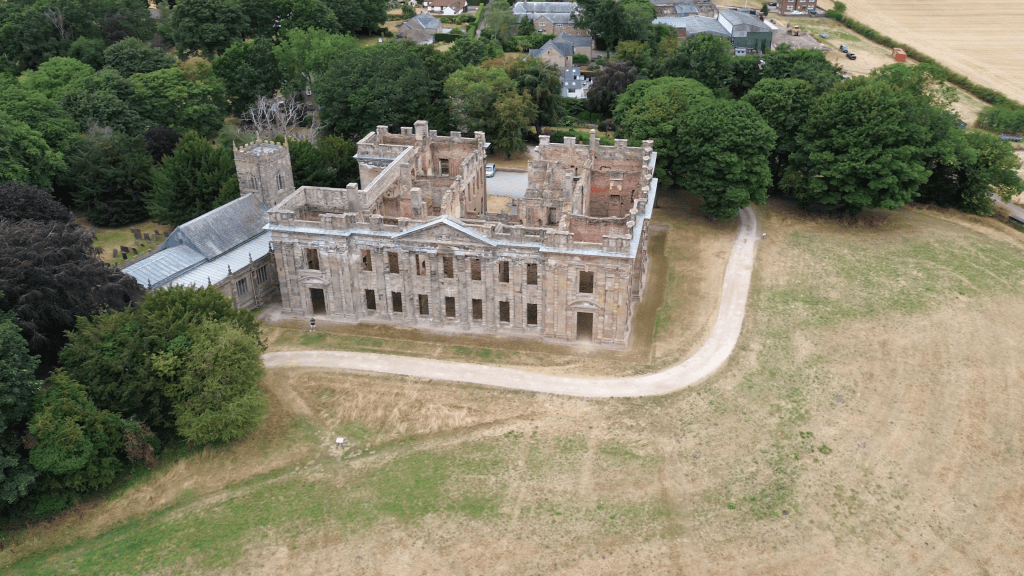
Perched high on a ridge overlooking the windswept landscape of Derbyshire lie the ruins of Sutton Scarsdale Hall—one of England’s most striking and tragic architectural marvels.
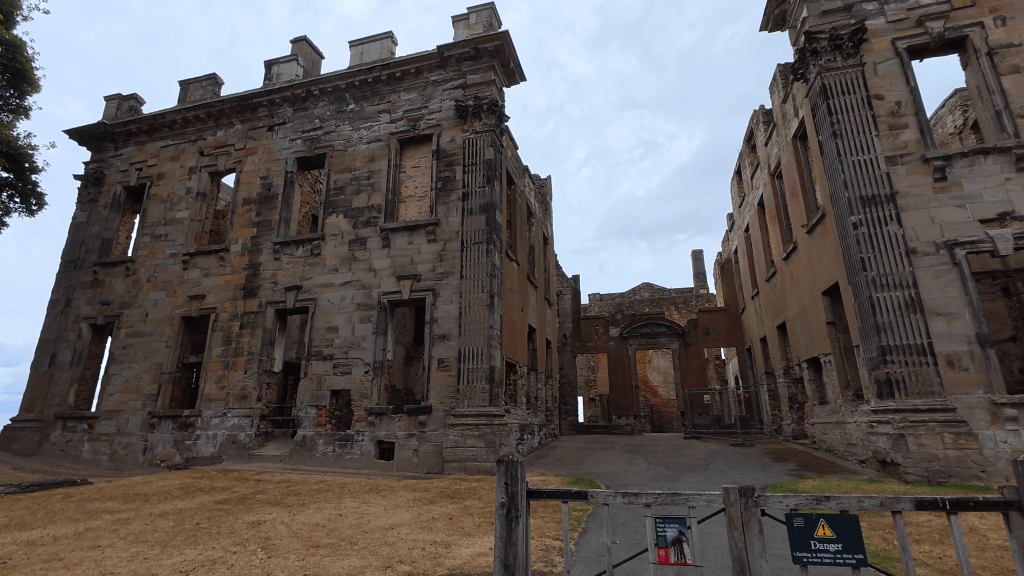
To the unsuspecting traveler driving through the countryside, it appears suddenly on the horizon like a majestic mirage: a massive, roofless Georgian palace whose immense stone columns, elaborate pediments, and hollow window frames stare silently out into the void. It is a place where breathtaking 18th-century aristocratic ambition collides violently with 20th-century destruction. The haunting shell of stone holds within its walls stories of staggering wealth, political ruin, hidden treasures, and chilling ghost stories.
Long before the current grand ruin was built, the land at Sutton Scarsdale had been occupied for centuries. Mentioned in the Domesday Book of 1086, it was home to medieval manors and later a Jacobean mansion. But the story of the hall as we see it today begins in the 1720s with one man’s obsessive drive for status: Nicholas Leke, the 4th Earl of Scarsdale.
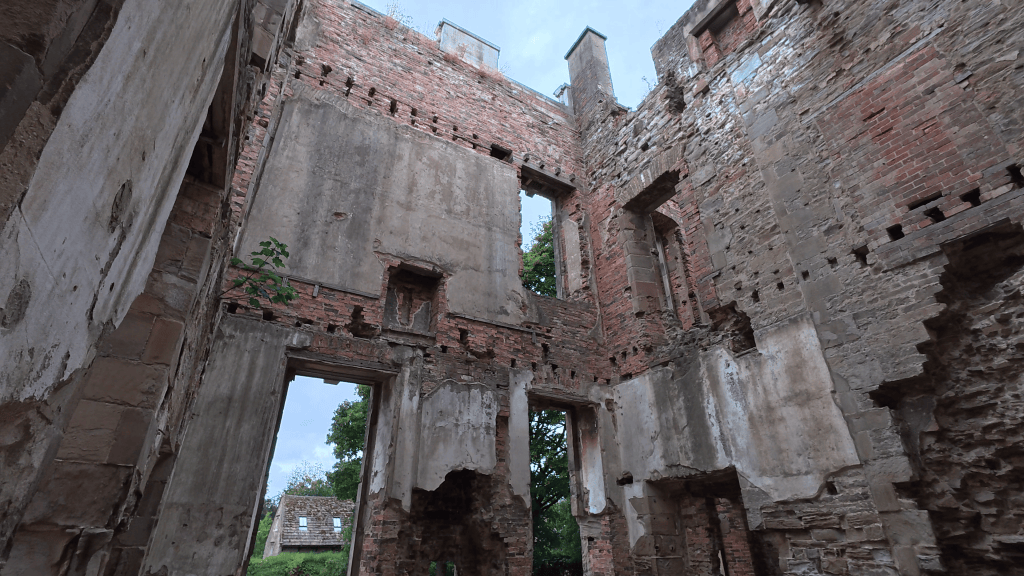
Determined to outshine his noble rivals and showcase his immense family wealth, Lord Scarsdale hired Francis Smith of Warwick—one of the most sought-after master builders of the Georgian era—to construct a palace that would rival the finest country estates in Britain.
When completed around 1724, Sutton Scarsdale Hall was an absolute triumph of Classical Baroque design. Its main facade featured nine grand bays anchored by majestic Corinthian columns, topped with carved stone crests. Inside, it boasted some of the most intricate Italian plasterwork in Europe, crafted by the legendary Venetian plasterers Francesco Vassalli and Giuseppe Artari. It once had sweeping oak staircases, gilded velvet drapery, and ballroom ceilings adorned with plaster gods and mythological scenes that filled the residence with breathtaking luxury.
Yet, Lord Scarsdale’s obsession with perfection proved to be his undoing. He poured vast fortunes into the estate, driving himself into catastrophic debt. When he died in 1736, he was so financially ruined that his body lay in state in a house stripped of assets, and the title of the Earl of Scarsdale died with him.
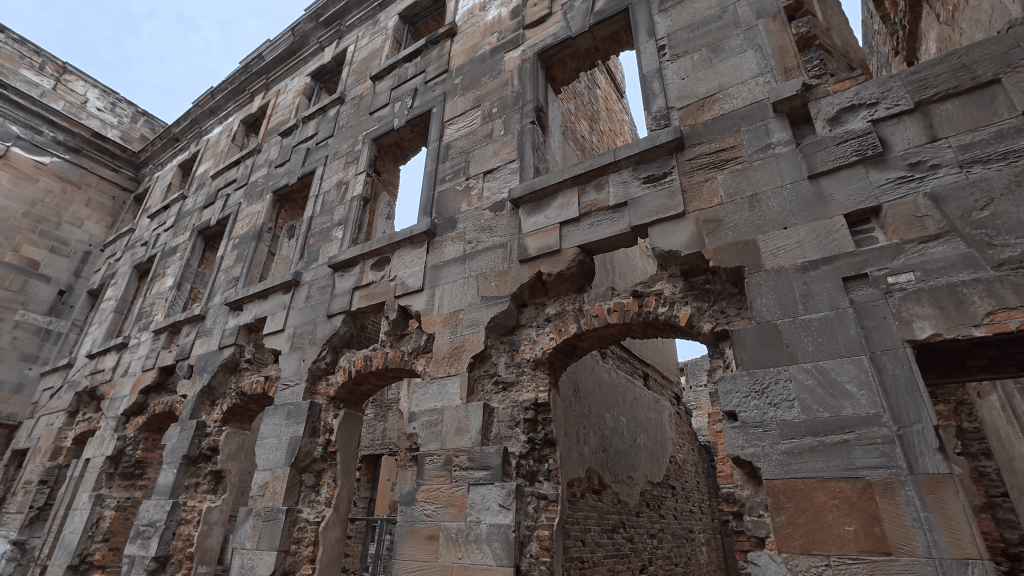
The estate passed through various prominent families, including the Arkwrights (heirs to Sir Richard Arkwright, pioneer of the Industrial Revolution), but its most heartbreaking chapter was yet to come. Following World War I, many British country houses fell into decay, but Sutton Scarsdale suffered a uniquely ruthless fate. In November 1919, a syndicate of local asset strippers bought the estate not to live in, but to break apart for profit.
They systematically pillaged the palace by stripping the roof of its valuable lead, exposing the delicate plaster ceilings and carved oak beams to the brutal Derbyshire rain and frost. Across the Atlantic, the magnificent carved wooden paneling and ornate marble fireplaces were torn out and sold at auction. Remarkably, several entire rooms of paneling were purchased by American newspaper magnate William Randolph Hearst, and today, parts of Sutton Scarsdale’s original oak paneling and fireplaces are installed in the Philadelphia Museum of Art in the United States.
By the 1940s, the once-glorious palace was a gutted, crumbling ruin slated for total demolition. It was only saved at the last minute by a local businessman, Osbert Sitwell, who purchased the shell to preserve it as a monument to Britain’s vanishing heritage.
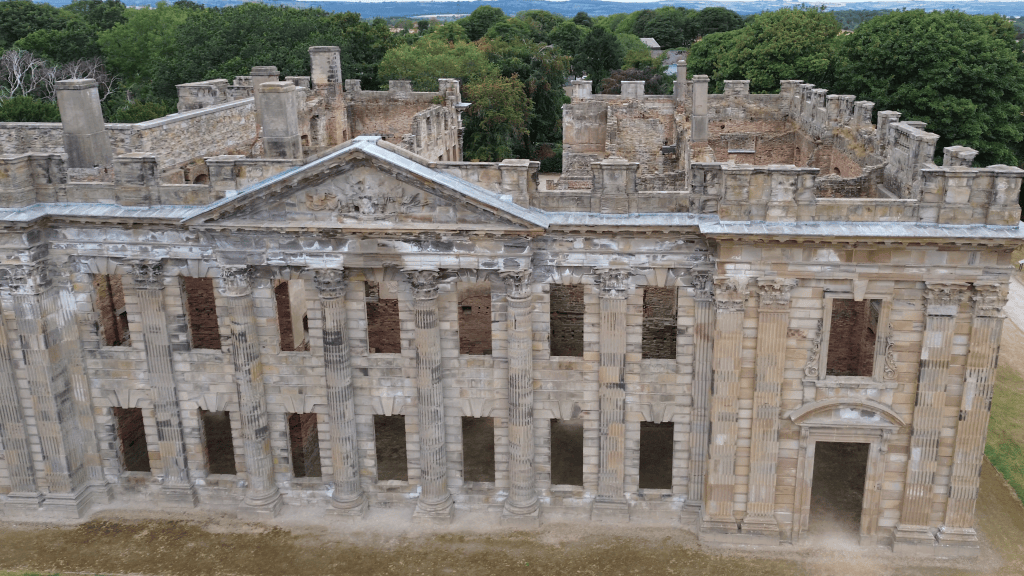
In more recent years, Sutton Scarsdale’s eerie, tragic beauty caught the attention of Hollywood filmmakers. In 2016, the decaying, roofless shell was digitally scanned to serve as the real-world inspiration for the burnt-out, destroyed remains of Wayne Manor—the ancestral home of Bruce Wayne—in the blockbuster movie Batman v Superman: Dawn of Justice. Its grand, hollowed-out classical columns provided the ultimate cinematic backdrop for a ruined noble legacy.
Sutton Scarsdale Hall is far more than a roofless, lost building. It is a monument to human vanity, architectural beauty, and the relentless march of time. Standing beneath its towering stone pillars with the wind whistling through empty window frames, you can almost hear the faint echoes of 18th-century ballroom music mingling with the rustle of leaves. This site is a true phantom palace standing proud on its Derbyshire hill.
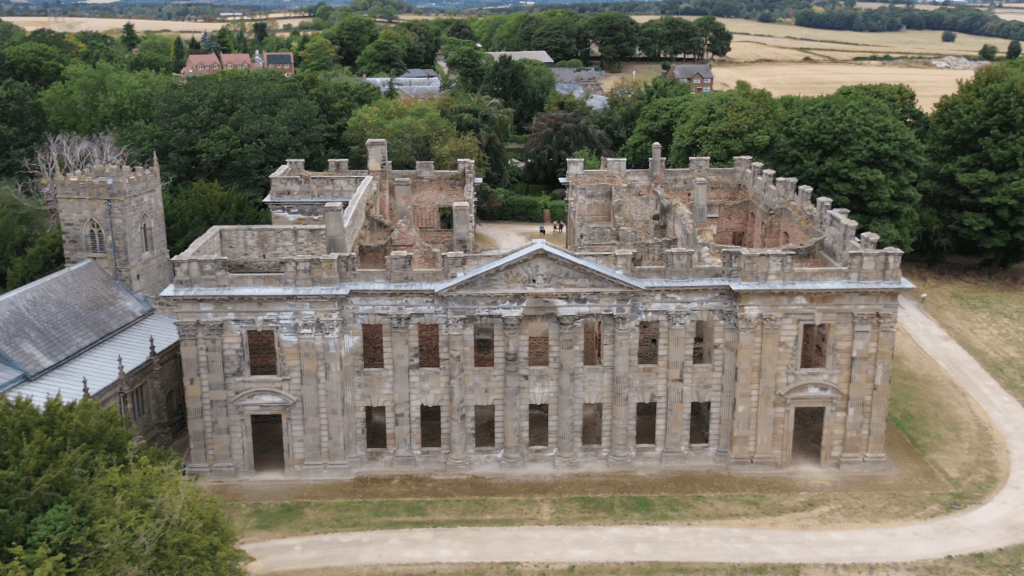
Whether you come for the Hollywood film history, or simply to stand beneath those colossal Corinthian columns as the wind whistles through the hollow walls, Sutton Scarsdale delivers an unforgettable sense of drama.
If you liked the blog please hit that like button, watch the full video below and consider subscribing if you haven’t already.
Till Next Time!


Leave a Reply