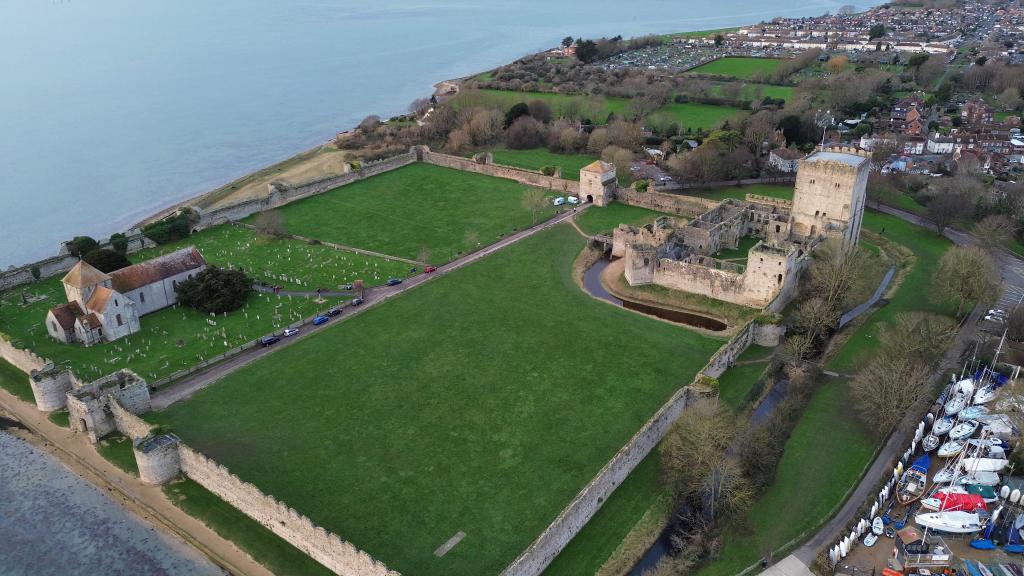
In this post, we are visiting a castle that holds a commanding position at the north end of Portsmouth Harbour, located in the south of the UK. This site could very well be considered one of the oldest castles in England, seeing as its outer walls were originally part of a Roman fort. From Roman defense to Saxon settlement, and from royal hunting lodge to prisoner-of-war camp, this castle has served many purposes. While there are many places in England with long histories, few can rival this site; it has been at the heart of the English story for over 1,500 years. This is Portchester Castle.
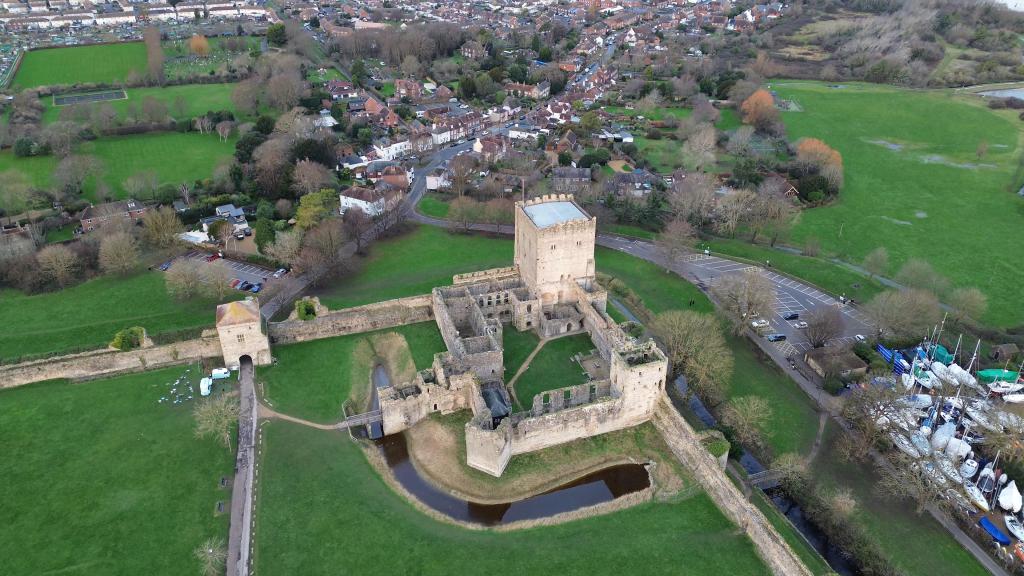
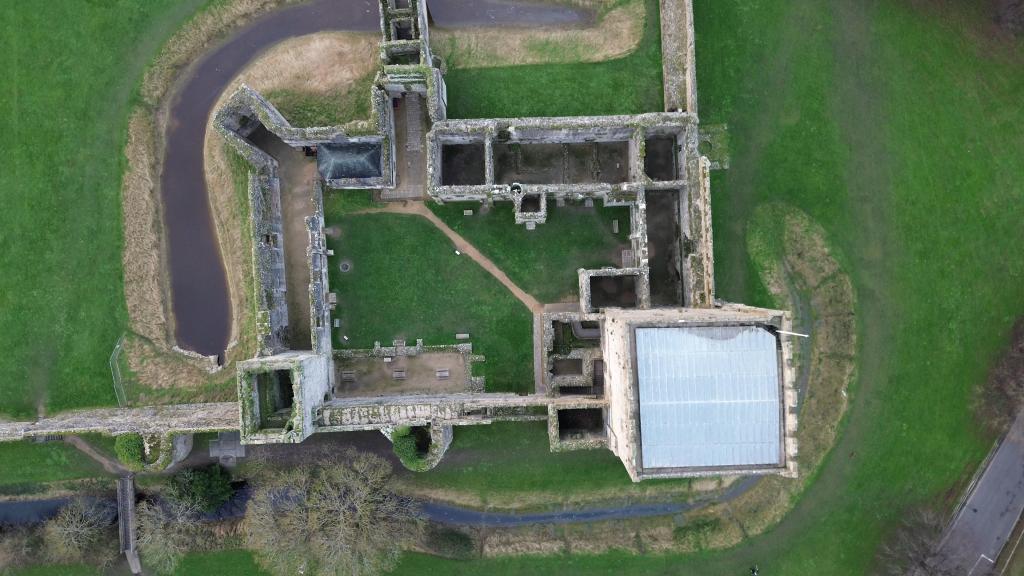
Six miles northwest of the city of Portsmouth, on the harbor’s northern shore, Portchester Castle sits overlooking the English Channel. It was built originally as a Roman fort, one of a series of coastal defenses now known widely as the Forts of the Saxon Shore. These forts were constructed around the 3rd century to meet the ongoing threat presented by Saxon pirates who were raiding the south coast of Roman Britain at the time.
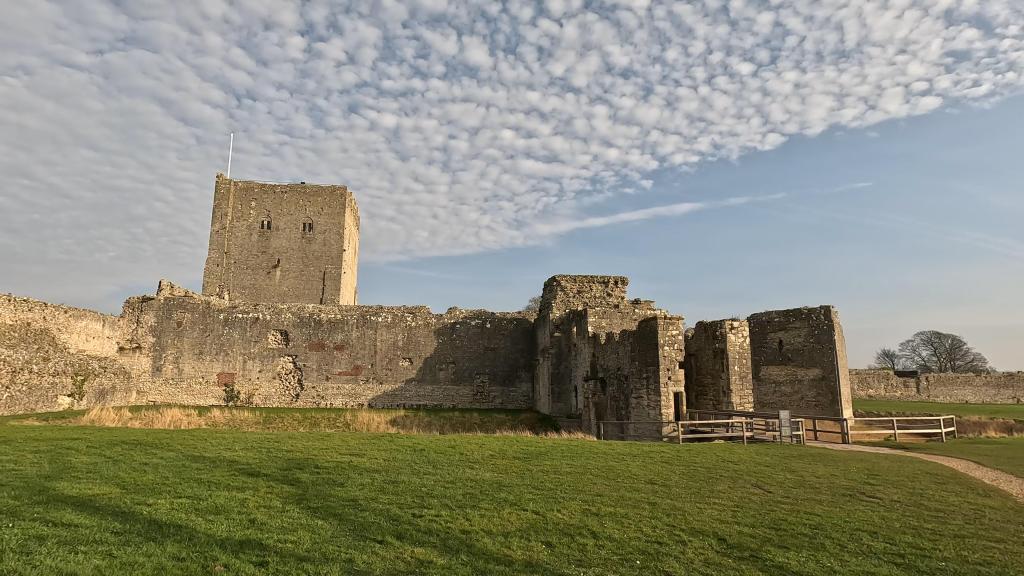
The huge stone walls, built from flint and limestone, are mighty, well-preserved, and impressive. The location provided the perfect site to set up defenses, and the fort remains one of the most complete Roman structures in Northern Europe. Once known as Portus Adurni, this enclosure forms the core of what would become the present-day castle.
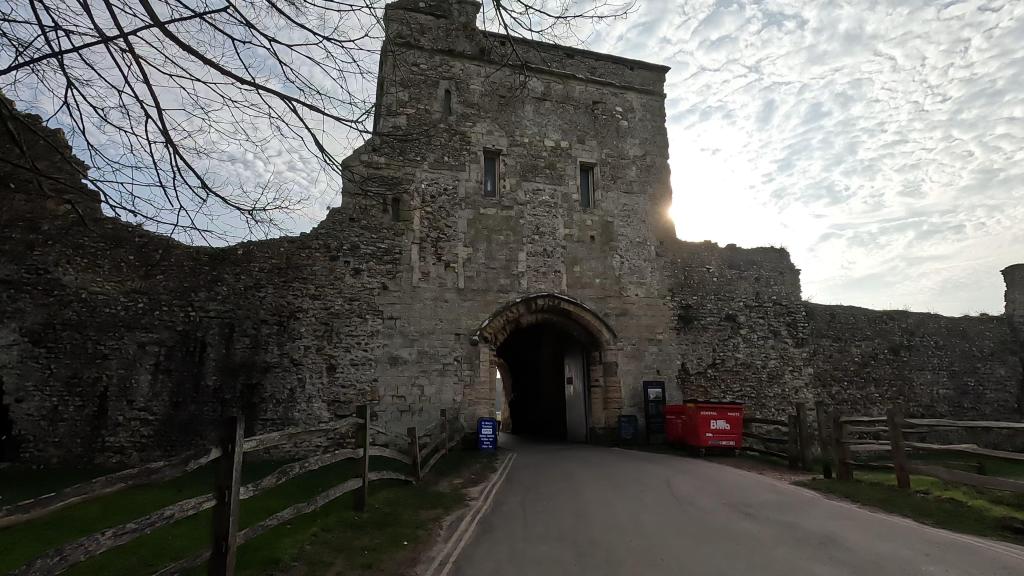
While it is clear the fort was founded here because of its commanding position at the head of a huge natural harbor, there is no definitive date for the original construction. However, coins excavated from the site are dated to 268 AD. It is thought that the fort was constructed under the rule of Marcus Aurelius Carausius, a mighty Roman emperor and military commander in the 3rd century.
Unlike many Roman sites in Britain, the topography around Portchester has changed little over the centuries, allowing us to easily imagine the fort in its original state. Portchester was likely a base for the Classis Britannica, the Roman fleet defending Britain. Although the Roman army retreated from Britain in the early 5th century, it is unlikely that the fort was ever completely abandoned, though its use continued on a much smaller scale.
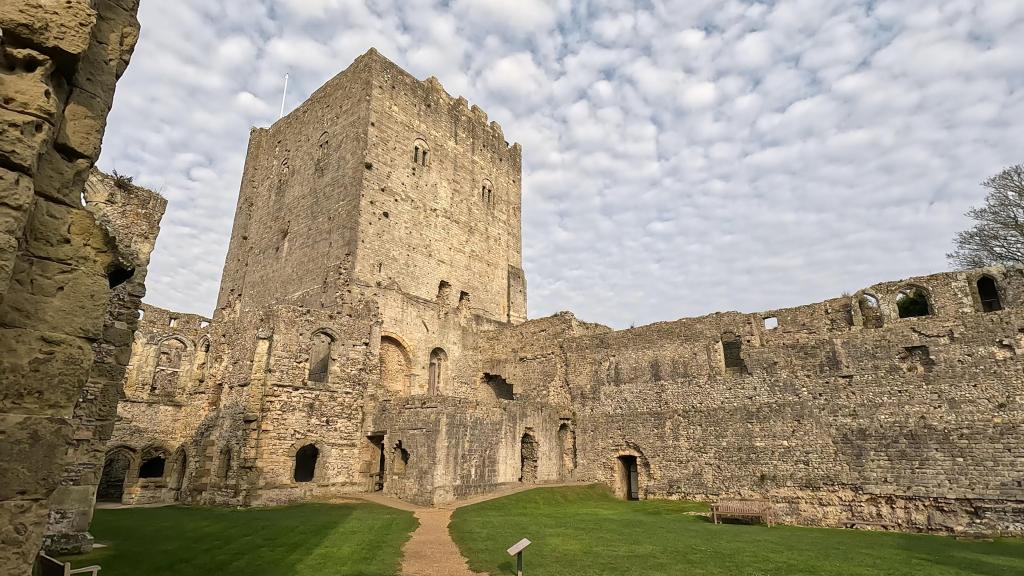
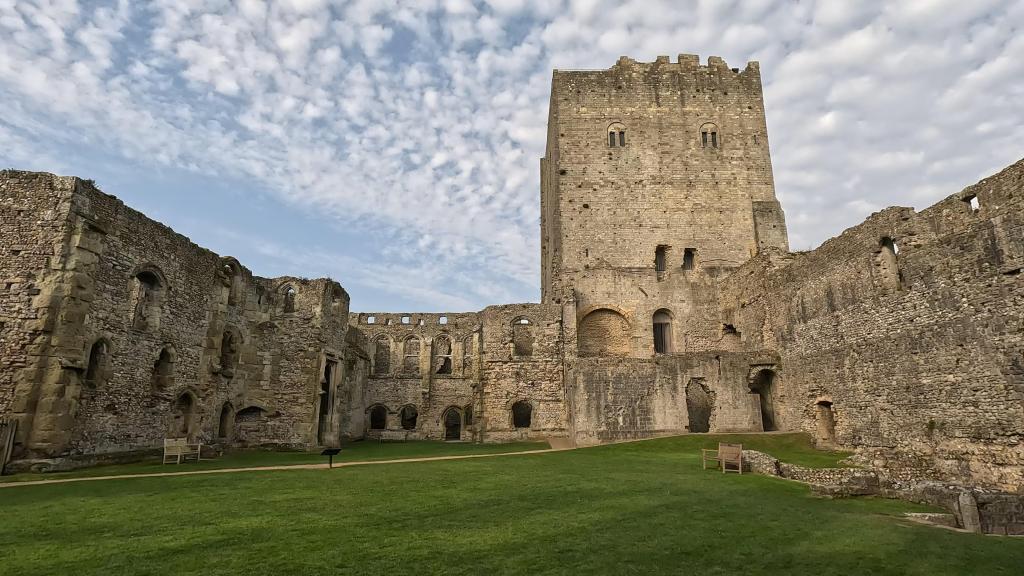
Following the Norman Conquest of 1066, Portchester entered its medieval phase. William Maudit, an associate of William the Conqueror, was likely the first to build here, constructing a timber motte-and-bailey within the Roman fort to create an inner ward. Sometime around 1130, the Norman lord William Pont de l’Arche reinforced the walls and established a stone fortification. He added a stone keep and laid out an inner bailey with secondary buildings to support a garrison. Around the same time, he established an Augustinian priory inside the Roman enclosure, though the priory later moved to Southwick.
The great stone keep, standing proudly at over 30 meters high, dates from the 12th century. Built on a square plan, it contained the most important apartments in the castle. Our exploration leads us first to the keep basement, which was transformed into a theater by French prisoners of war between May and August 1810. This is a fantastic recreation based on first-hand historical descriptions.
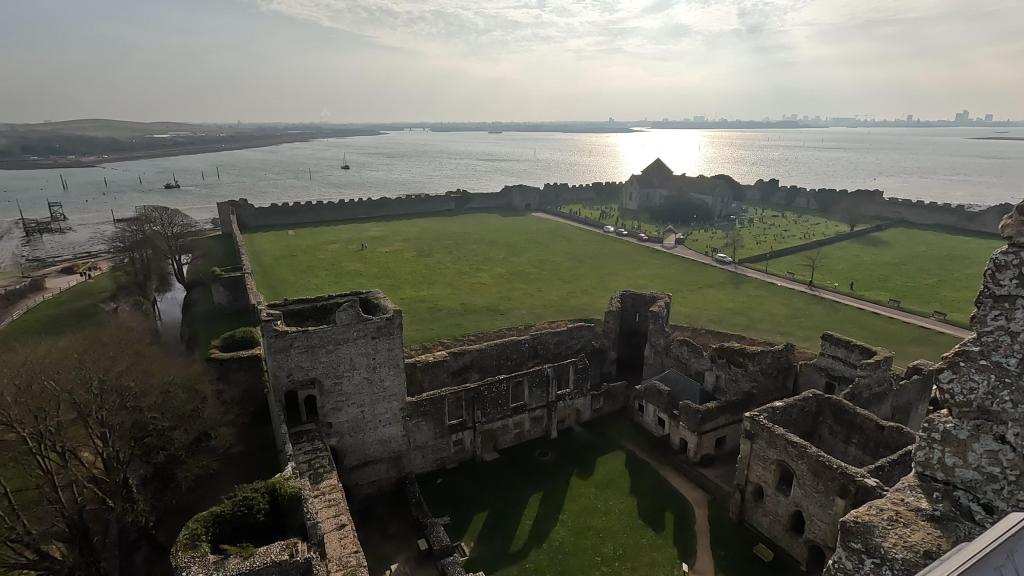
Ascending the steep spiral staircase leads to the wall walk. Looking out across the harbor, you can see familiar landmarks of Portsmouth and the walls of the Roman fort encircling the site. On the third floor of the keep, there is an almost life-sized sculpture of a rowboat with three Black people inside—a woman, a man, and a small boy. This represents a remarkable and often overlooked part of the castle’s life when it served as a prison for up to 8,000 captives.
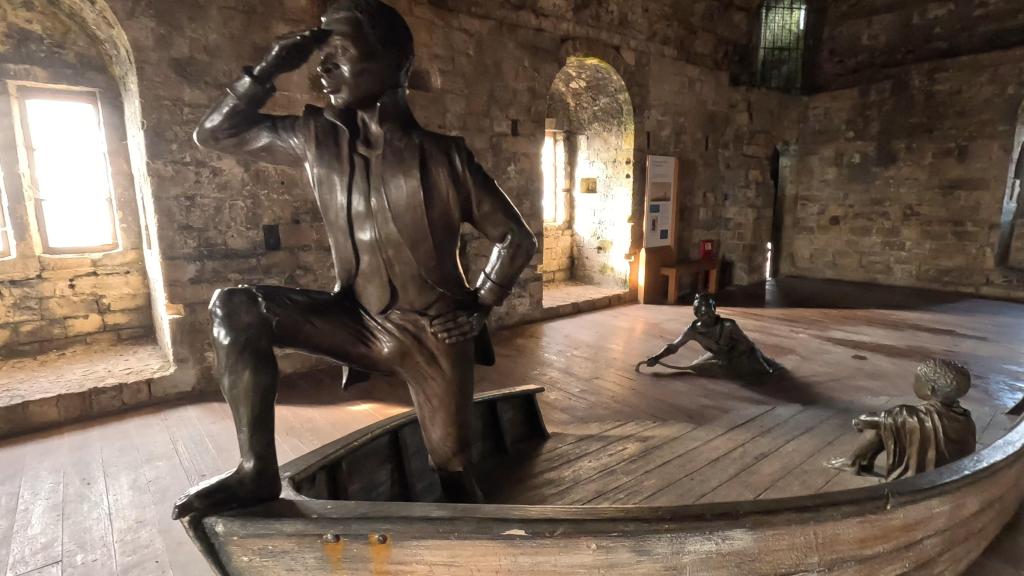
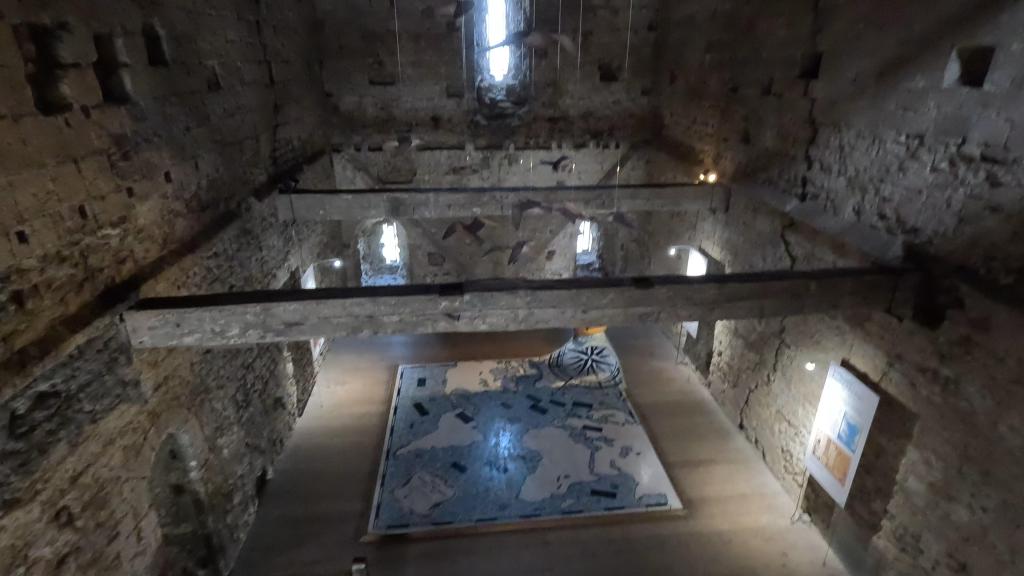
Portchester was an international prisoner-of-war camp. While many prisoners were French, the population also included Spanish, Danes, Americans, and over 2,000 Black and mixed-race prisoners of war from the Caribbean. Their story began in 1794 during the Revolutionary Wars when the French ended slavery on Guadeloupe and recruited newly free citizens to fight against Britain.
In 1796, after the surrender of Fort Charlotte on St. Lucia, more than 2,000 Afro-Caribbean soldiers and their families were brought to the Solent. Treated as prisoners of war to be traded for British captives, they arrived as winter set in. It was a complete culture shock. Facing bullying from European prisoners, the Caribbean men were eventually moved to two prison hulks moored off the castle for their safety.
Notable captives included Louis Delgrès and General Marinier. These individuals were not slaves, but free men and women fighting for a cause. Delgrès was eventually released to the French and returned to Guadeloupe, where he led the resistance against the reinstatement of slavery until 1802.
The story of Portchester is vast, interesting, and inspiring. If you get the chance to visit, this site must be on your list. We didn’t manage to fit in everything there is to experience here, so we’re leaving the rest for you to discover.
If you liked the blog please hit that like button, watch the full video below and consider subscribing if you haven’t already.
Till Next Time!
 Pinned on Places
Leave a comment