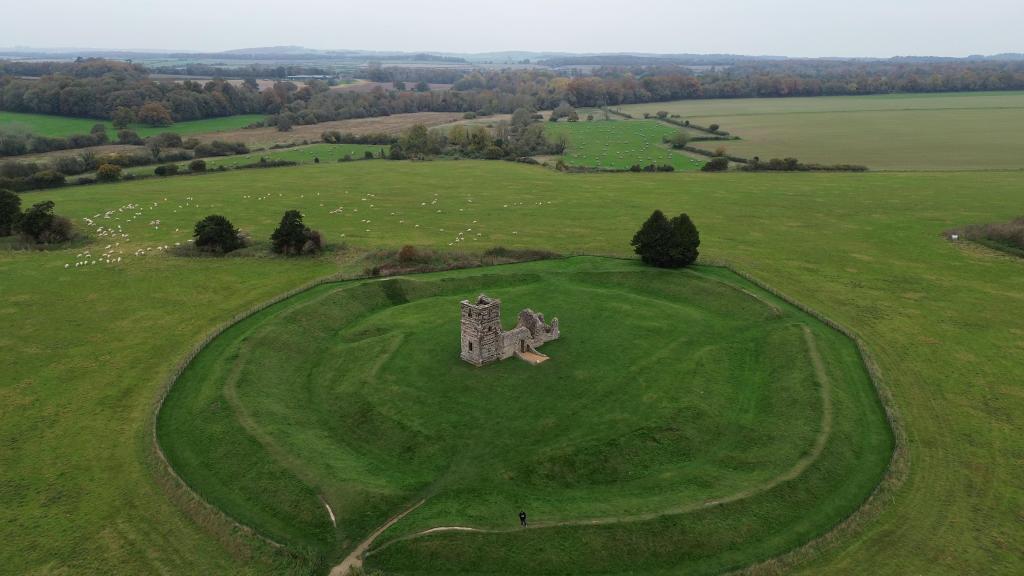
Known famously as Dorset’s most haunted ruin, this site is heavily thought to have a dark and menacing atmosphere with a number of folklore tales keeping the place alive, the rarity of having a medieval ruin inside of prehistoric earthwork remains are fascinating and one that we are looking forward to sharing with you all, so join us for a walk around Knowlton Church.
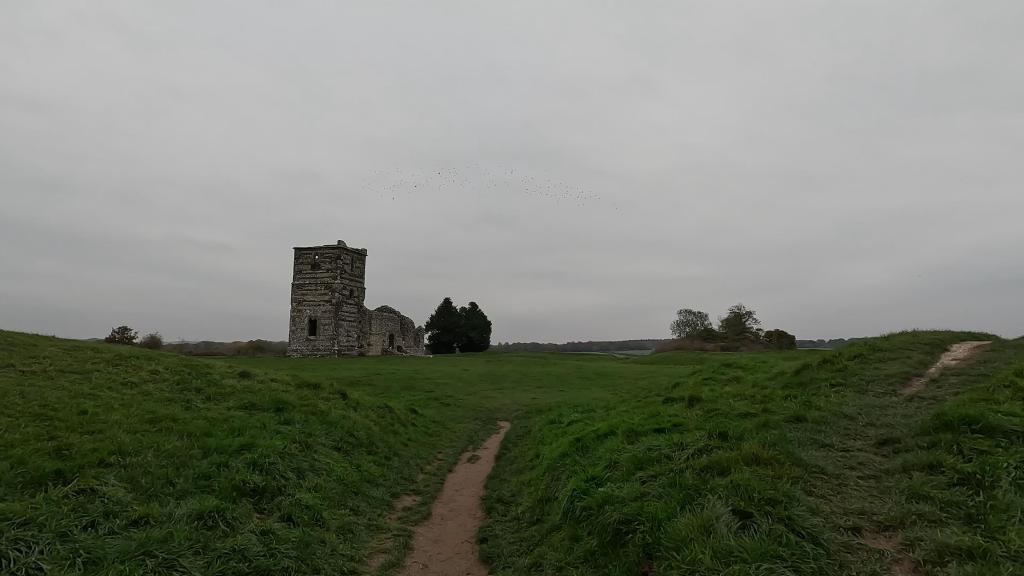
Infront of us are the remains of Knowlton, a church set within an ancient earthen henge which forms the huge outer circle around it. The church building dates to around the 12th century,. yet the henge however is at least 4500 years old, it’s a striking vision of spiritual continuity in one place. The building of a church slap bang in the middle of a pagan site is quite the bold mood but the Christians wanted to make an assertive statement of their cultural dominance.
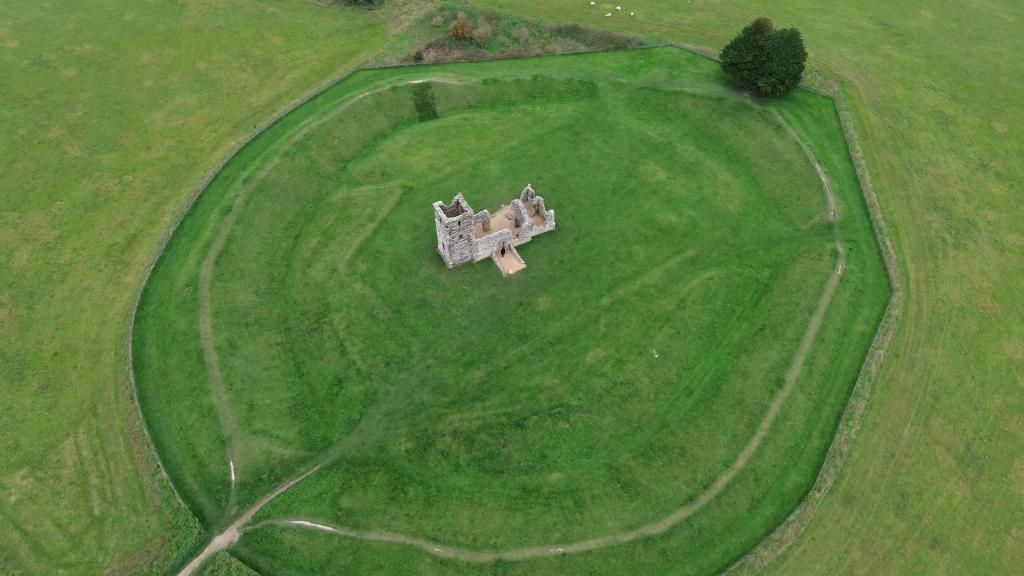
The main earthwork at Knowlton is a type known as a henge, there are nearly over 100 henges scattered across Britain and Ireland dating from around 3000 and 2400 BC. Among the most famous are Stonehenge and Avebury. Although they are generally believed to have been used for ceremonial purposes it is likely that they would have fulfilled by a number of functions and throughout the years they would change their purpose and role.
The area surrounding Knowlton Church is part of Cranborne Chase and is filled with several ancient remains. Named Church Henge, this is just one of four earthworks in this immediate vicinity and surrounding these is one of the greatest clusters of round barrows in Dorset. This includes Great Barrow, which is the single largest round barrow in the county. It’s not been completely defined exactly what henges were used for, whilst they weren’t defensive they could have served a number of functions, over time they would become ritual sites, meeting places and even later possibly cattle enclosures.
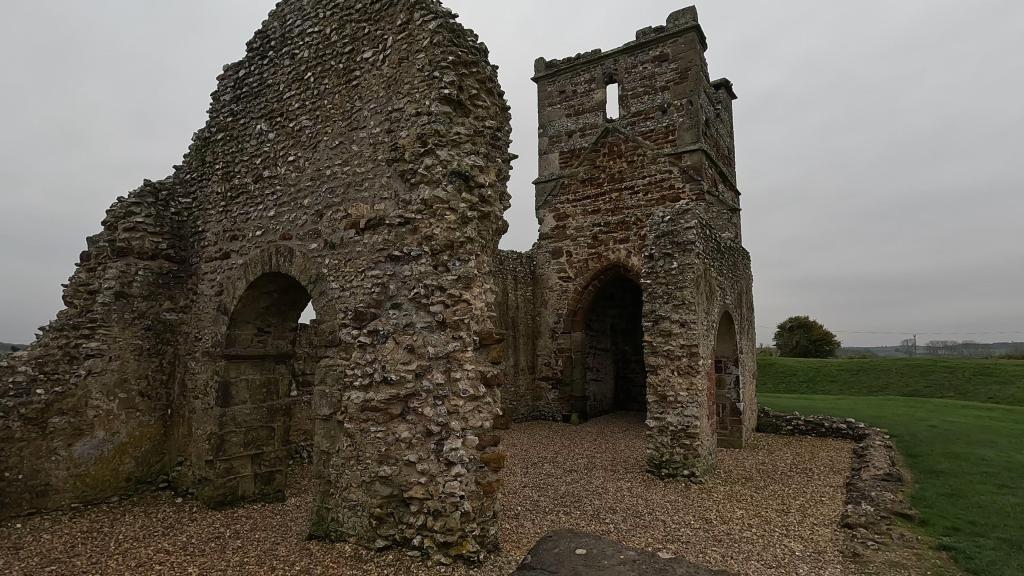
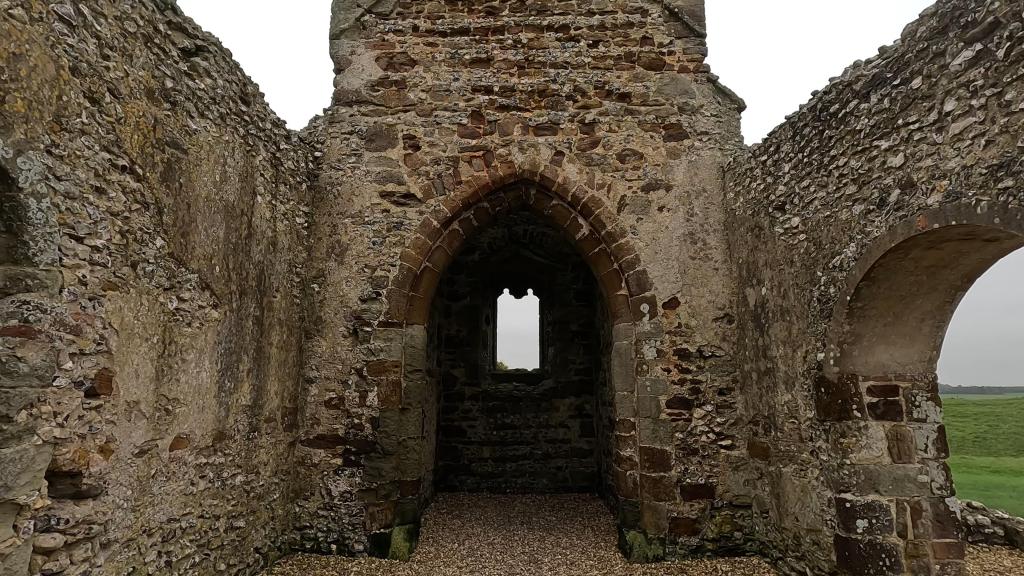
The construction of the church is of flint and stone, and was originally constructed in Norman times, with the North chapel and tower dating to the 15th Century. Some of the stone is also said to come from the broken up standing stones. On the site there is a large slab, thought to have been part of a stone circle which was widely believed to have been either knocked down or broken up when the 12th century church was built on the same spot, it’s also suggested that other stones may have been used in the church’s foundations and to form part of the altar.
These days the church seems awfully isolated and mysterious but in it’s earlier days it was the very centre of a thriving community known as Knowlton Village. The village itself was sadly decimated by the black death in the 15th century when all of the villagers either died or would leave for new beginnings, yet the church continued to be used for several hundred years until the roof collapsed in the 18th century.

What’s interesting about Knowlton church is that its been understood and told by the locals that there were originally seven churches here built on this very same site, yet six of them had just completely vanished and disappeared overnight. It could have been understood that the people likely mistook the prehistoric banks and ditches as churchyard walls, as there is only evidence for the one. Or a false assumption that each of the neolithic enclosures once had it’s own.
Sadly, it completely went into disuse by the 1650s and was in a total ruin by 1730, when it’s bell was taken, carried off and moved to Sturminster around 12 miles down the road. According to folklore though, this was theft and many tales have sprung up around the bell’s removal from the old church for centuries.
Of course with this stunning place left standing still, isolated and ruinous it is said to be haunted, in fact it’s said to be the most haunted place in Dorset. it has an air of mystery and intrigue as well as a presence about it that nudges your curiosity to delve into more.
Some myths and legends surrounding Knowlton tell us that the church originally had three bells, one bell went to Sturminster, one to Shapwick and one, the most famous of all would remain in the tower, but there are many versions of what happened to this particular bell. Some will say the devil stole it, and would discarded it in local river nearby, but others will claim that thieves from Sturminster wanted it for their own church so they would go about to devise a plan to steal it.
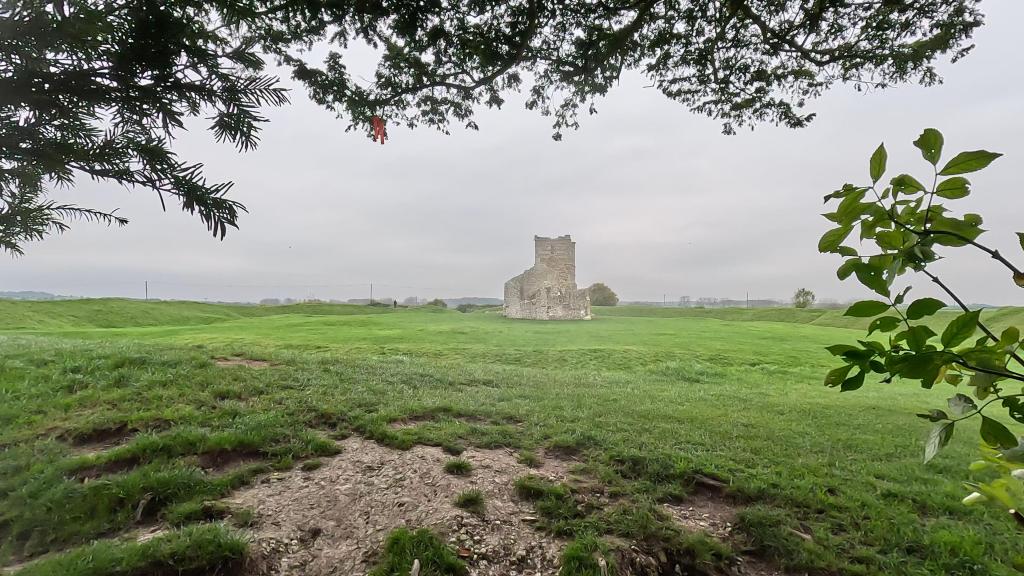
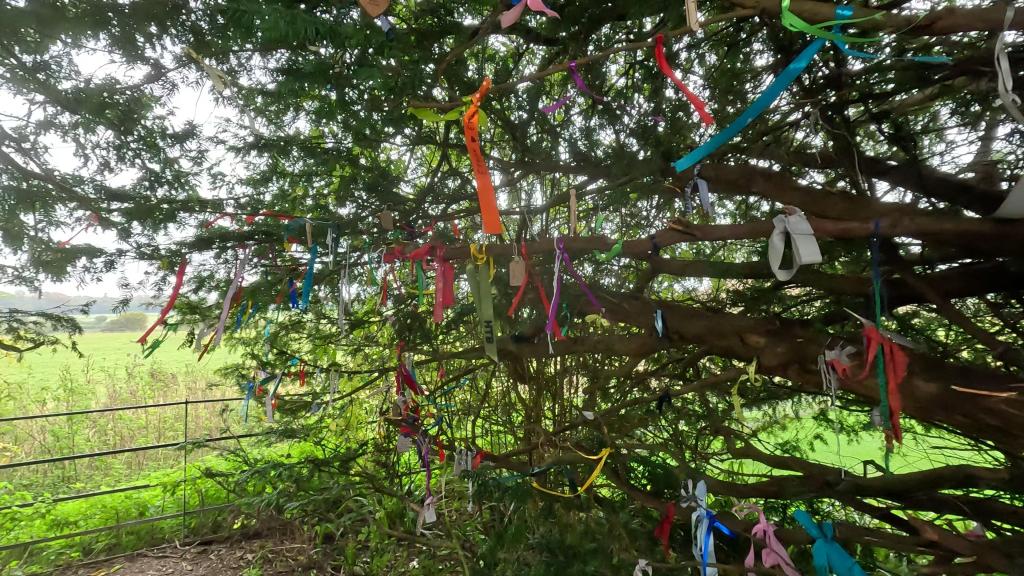
Before leaving the site, we wandered over to the type of wishing tree, created on the edge of the earthwork and between 2 large yew trees, the trees once made up the south entrance to the site and really have become something of a spectacle in themselves, as visitors have endowed them with all manner of decorations. Ribbons, friendship bracelets and scarves which sit comfortably alongside small memorials.
These range from touching tributes to parents who have passed away to notes left by children to commemorate their deceased pets. There’s something rather lovely about all this, in the way it seems to have grown organically by word of mouth, and somehow takes the site back to its roots in the worship and celebration of the forces of nature. This site still proves to be a draw to local people as well as those farther afield.
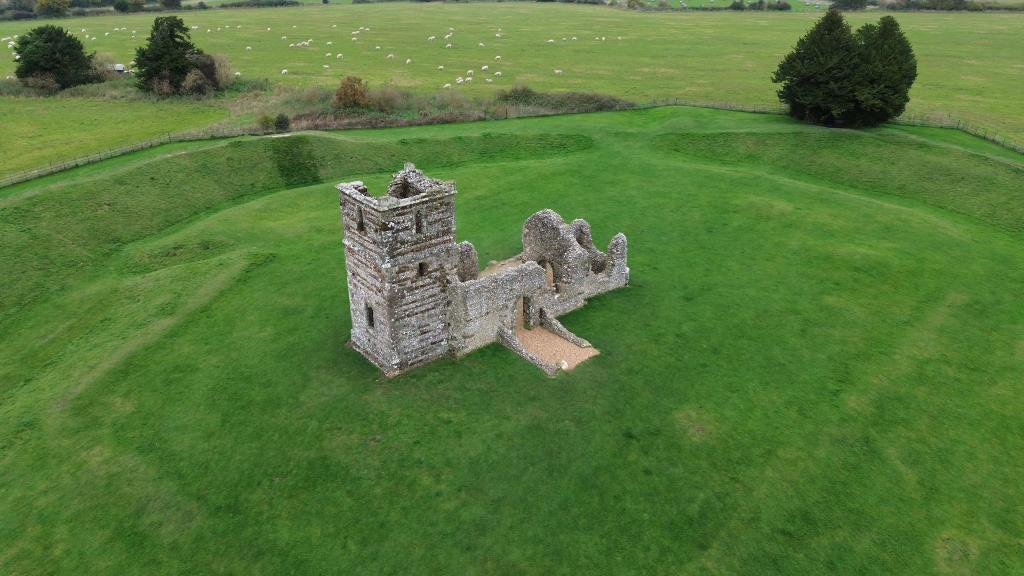
It’s undeniable that there is a special energy to the place. It’s hard to forget Knowlton Church and Earthworks once you’ve seen it first-hand. You’ll soon be drawn back, delighted to find you’re just as fascinated and intrigued as the first time you arrived.
As at so many of these sites, what remains is far less than that which has been lost. the interior of the henge provides a feeling of sanctuary and otherworldliness. The ruined church further enhances this atmosphere, lending an air of gothic mystery.
If you liked the blog please hit that like button, watch the full video below and consider subscribing if you haven’t already.
Till Next Time!
 Pinned on Places
Leave a comment