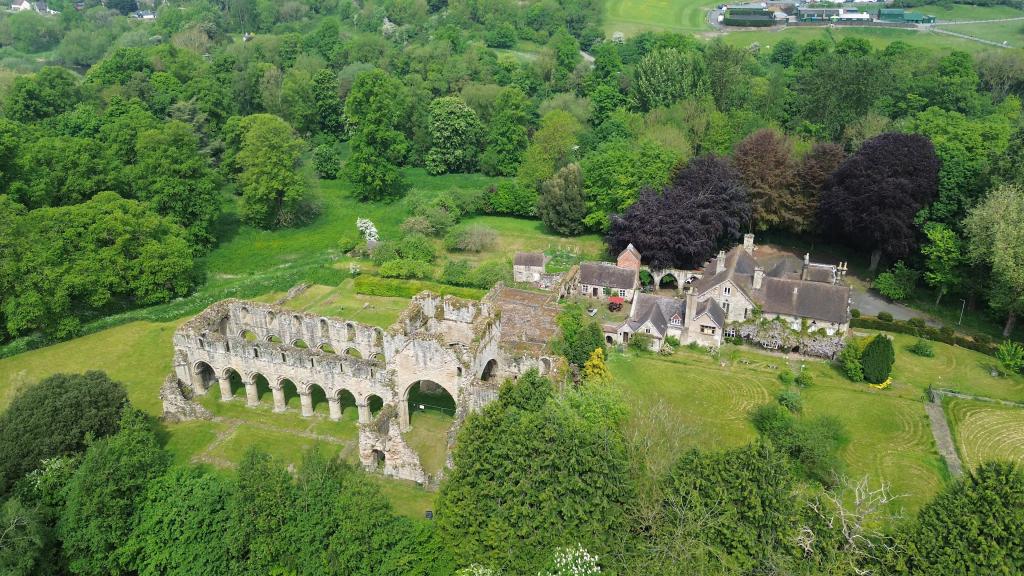
The ruins of this Cistercian abbey of Buildwas that sits in stunning countryside, with the imposing River Severn below and the beautiful historic towns of Much Wenlock and Ironbridge nearby. So join us whilst we take a walk around Buildwas Abbey.
The impressive ruins of the abbey date as far back as the 12th century. What’s interesting is here at Buildwas much of the remains of the main building are still rather complete that we don’t think it’s hard to imagine just how Buildwas Abbey would have looked in its heyday and functioned. In its time, the abbey withstood the murder of an abbot by one of his own monks, there were raiders from wales pillaging its treasures and taking prisoner the abbot and monks, and its estates being ravaged during a Welsh uprising led by Owain Glyndŵr, as well as a decline in the economy and the arrival of the Black Death.

In the summer of 1135, Roger de Clinton, who was the local Bishop of Coventry, brought a small group of monks from the Norman abbey of Savigny to Buildwas to settle the area. It was around some twelve years later that Buildwas Abbey joined the Cistercian monastic family. And as the abbey grew more prosperous, new buildings were constructed, and the striking abbey church that we see today was built somewhere between 1150-90. The abbey became very prosperous particularly under Abbot Ranulf in the 12th century.
Not much is known on his background or family but what is known and can be seen is his energy and ability that has been left through the history of the abbey. The chapter house, the church and cloisters all appear from their design and from detailing of decoration to have been built throughout his abbacy. Of 40 surviving books known to have belonged to the library here over a dozen of them were written in the 12th century. Buildwas for Ranulf was a centre of learning, with a considerable library and he was the owner of many acres of peasant land, which grew crops and housed cattle.

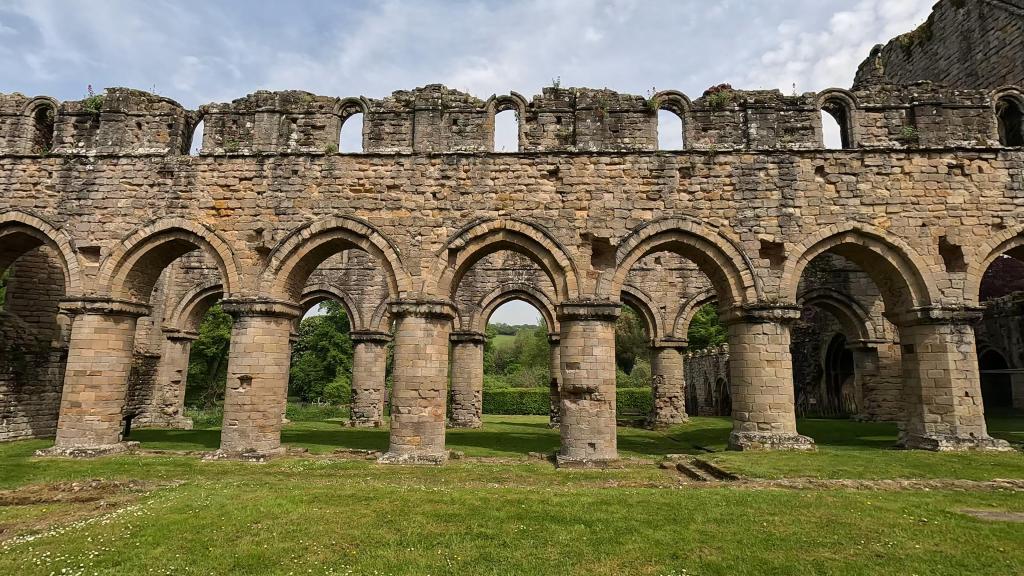
When visiting the site you are near enough always drawn to visiting the remains of the church first, you’ll first notice the incredible columns which run to their full length before looking at the crossing in the centre of the church. There aren’t many records to tell us a lot about the progress of construction work on the church, though the architectural evidence does suggest that it was begun around 1150 and may have been finally completed around 1190. The design chosen was quite typical of the Cistercians from the 12th century onwards. One of the main draws at Buildwas lies in the fact that, unlike so many of the other abbey churches of this era, Buildwas remained largely unaltered throughout the later Middle Ages. The walls of the finished church were coated, inside and out with a thick rendering of plaster and this was in turn covered with an off white lime wash, then marked out with lines to suggest joints of fine quality masonry. The lines were probably once a deep red colour, a colour which was favoured not only by the Cistercians, but generally in this region.
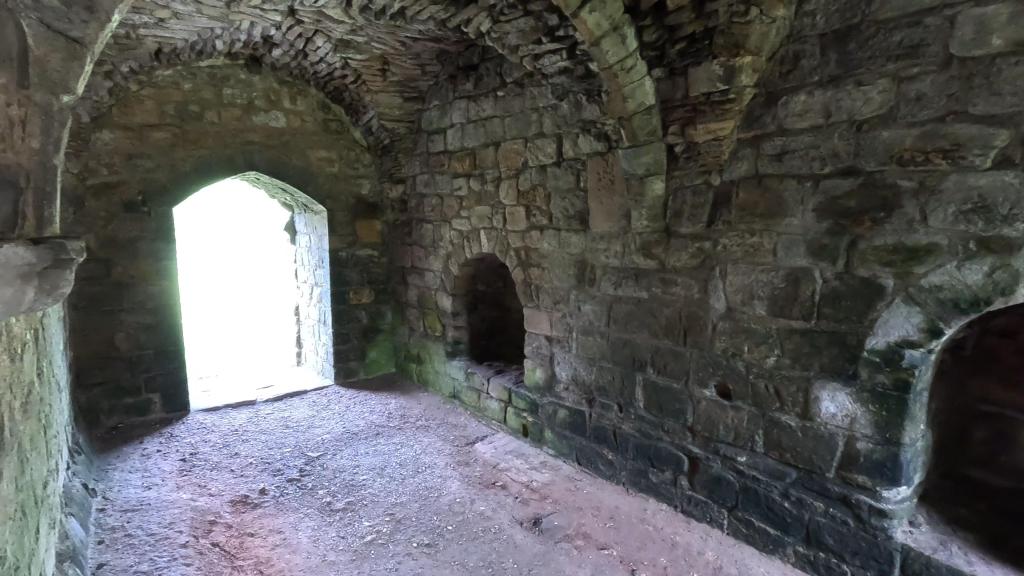

From the north transcept, we journeyed around the sacristy and book room. Down the steps in this section it leads into a two bay vaulted chamber. There are two cupboards that are set into the north wall. In ciscercian layout, you might expect there to have once been a partition that would have separated the two bays. If this was the case here at Buildwas then the west bay would have served as the book room where some of the abbeys most important and fine collection of columes could be stored for later use in the cloister. And the bay to the rear, entered by the steps like we did must have been the sacristy, usually where the vestments and alter cloths were kept in safety.
The chapter house is another notable part of the abbey that is in good condition. It was the place where the monks would meet every morning to review the rules of St. Benedict, discuss abbey business, receive messengers, and deal with all the big and small matters arising in a community. An impressive doorway leads into this chamber, and we can still enjoy the lovely, vaulted roof that suits a room of such importance. One of the more notable things to see whilst in the chapter house is the tiled pavement; these existing tiles at the centre of the room are all Buildwas examples that have been placed here in recent decades.
Built on the lower side of the abbey site, the west range accommodated the lay brothers, and the drop in ground height would have allowed storage below the ground floor. The building itself would have been two storeys. It was positioned away from the cloister in typical Cistercian fashion, allowing a gap, called a “lane”. The east range, also a two-storey building, housed the more senior monks, and was probably completed around 1180. Looking across the cloister towards the east range these days, the remains of several rooms can be identified. From left to right, the parlour, the chapter house, and the book room and sacristy.

Like many religious communities in the mid-fourteenth century, Buildwas suffered from poor monastic discipline, and – as if to add insult to injury, in 1344 the abbey was also in debt. Then, in 1350, the abbey was raided by the Welsh, who stole its treasures took the abbot and monks as prisoners. By 1377 the abbey had fallen on hard times with only six monks making up its congregation.
Four years later, this number had fallen to four. The Welsh raided again in the early fifteenth century, and during the Wars of the Roses the abbey lost land and had to lease property. Somehow Buildwas Abbey survived, only to head towards 1536 and the Dissolution of the Monasteries. In July 1537 Sir Edward Grey, Lord Powis, was given the abbey and almost all its land and property in Shropshire, Staffordshire, and Derbyshire.
Though Buildwas Abbey was never fully torn down, time took its toll. The grand stonework slowly gave way to nature, and what was once a thriving spiritual center became a quiet ruin. Eventually, people recognized its beauty and history, and today it’s protected by English Heritage. Walking through the remains now, you can still feel the calm and solitude that once defined life here—it’s like stepping back into a forgotten chapter of medieval England.
If you liked the blog please hit that like button, watch the full video below and consider subscribing if you haven’t already.
Till Next Time!
 Pinned on Places
Leave a comment