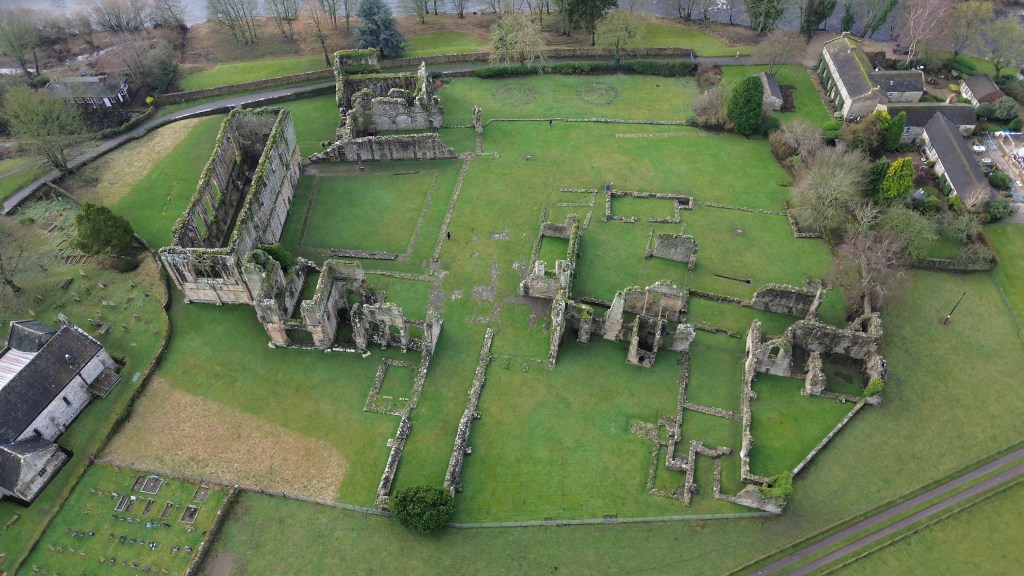
The Yorkshire Dales has such a wealth of incredible castles, listed buildings and abbeys that some of them are a little overshadowed. Most people have heard of Fountains Abbey, Bolton Abbey and Rievaulx Abbey and yet Easby Abbey is more unknown and outshined by those three in the area. So why not join us as we explore Easby abbey and St Agatha’s church.

Easby abbey lies on the fringes of the Yorkshire Dales, by the River Swale, close to the gorgeous historic town of Richmond. There’s a beautiful and quite easy walk from Richmond Station which is no-longer a train station, but now a lovely converted building with a cinema, food businesses and an art gallery along the river to the Abbey. Not far along the route will you come around the Drummer Boy Stone.
Legend has it that towards the end of the 18th century soldiers in Richmond Castle discovered a tunnel under the keep it was built as an escape route in the event of Scottish raids. The story goes that a drummer boy was sent into the tunnel, and the other soldiers marched above, following the route by the sound of the steady beat. After around half a mile, in Easby Wood, they heard no more drumming and the drummer boy was never seen again. The stone marks the place where the drumming ceased. Is this legend true? Who knows? But it’s a very sad yet interesting story that continues to tell its story.


Before we entered into the abbey itself we just had to visit the stunning St Agatha’s church alongside the abbey. It is completely worth visiting on its own or with the abbey for its wonderful collection of 13th-century wall paintings, which must rank among the best in Yorkshire and one of the most complete in all of England. The wall paintings were created around 1250 and were covered with layers of whitewash at the Reformation and amazingly only rediscovered in the 19th century.
In the window embrasures depict fascinating scenes of traditional medieval life, such as sowing seeds, digging and pruning a tree. There is also a scene of a nobleman hawking on horseback. These scenes are thought to be the traditional Labours of the Months, representing the traditional cycle of the seasons and its associated activities.
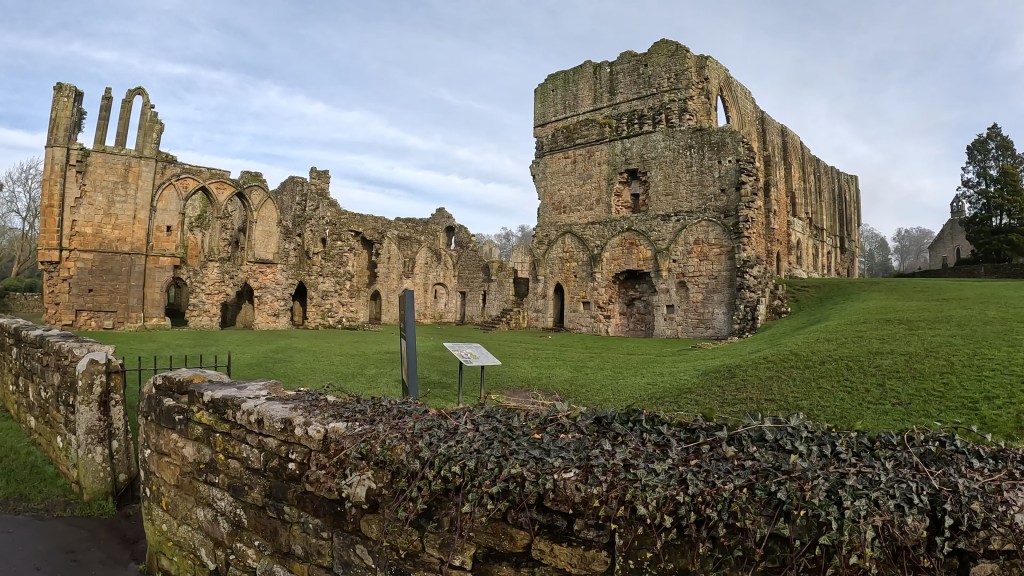
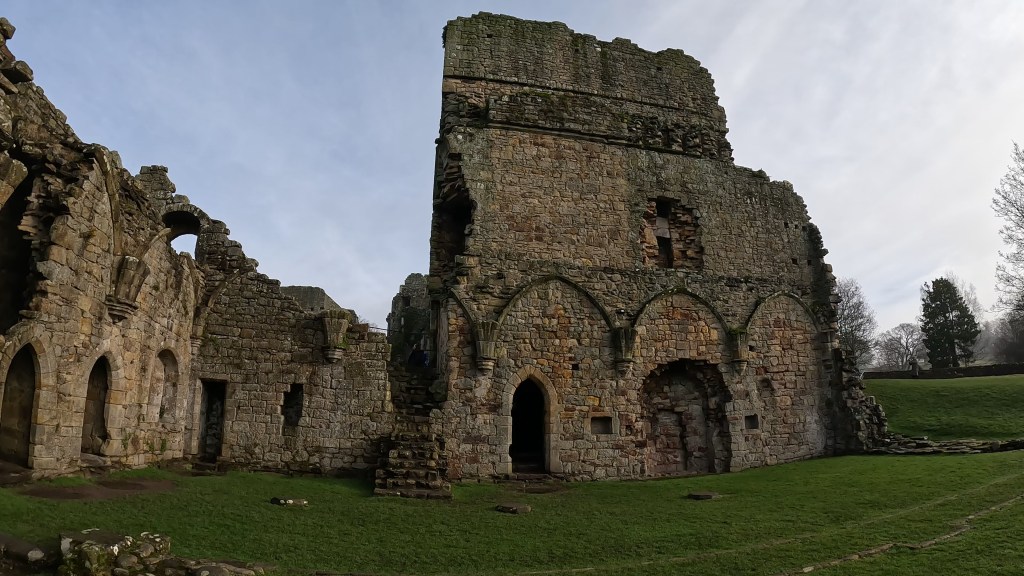
In 1152 Roald, the Constable of Richmond Castle, granted land to a group of Premonstratensian canons to build an abbey on the banks of the River Swale, within sight of the soaring towers of his castle. But Roald did not actually own the castle, but he administered it on behalf of his patron, Conan, the Earl of Richmond. But Roald was certainly a wealthy man, probably through marriage to Garsia, widow of Enisan Murdac, who held large estates around Richmond after the Norman Conquest.
The new abbey may not have been the first religious foundation at Easby; some circumstantial evidence suggests that there was a community of priests here in the Saxon period, perhaps associated with a minster church. It is quite unusual that Roald chose to establish a Premonstratensian house, though. The core abbey buildings included a church, sacristies (for keeping vestments, holy vessels, and written records), a cloister, dorter or (sleeping quarters), a toilet block, refectory, infirmary, chapter house, guest solar, and an abbot’s lodging.


The subsidiary buildings, further from the church, included a variety of barns and outhouses, a bakehouse, and a brewhouse. The precinct was entered through an impressive gatehouse, built in the early 14th century. The gatehouse would have been surrounded by a high wall and the doors would be closed nightly. The porter of the abbey could, however, open them for guests who had been delayed on their way or even pilgrims arriving after dark.
The large gatehouses like the one at here at Easby had rooms upstairs that could be used as offices or accommodation for the porter. Stores of items to be given as alms to the poor could be stored there so that they could be dispensed without the poor needing to enter the monastery. Alms were given out from a covered porch on the other side of the gate. Another use for the space on the upper floor was as a prison. Prisons were used to punish disobedient monks.

The abbey is free to visit and is a hotspot for people to park up their cars and indulge in a spot of walking through the forest aswell as a 4 mile circular hike that takes you through to Richmond Castle, around the river swale and to Easby Abbey. There is also free parking at the abbey itself but it runs on charitable donation, so if you are going to visit, it’s worth popping a few quid in the donation box to help keep St. Agatha’s church open. The area is absolutely beautiful and is worth a stop off or a tick off the list when it comes to exploring England’s Heritage.
If you liked the blog please hit that like button, watch the full video below and consider subscribing if you haven’t already.
Till Next Time!
 Pinned on Places
Leave a comment