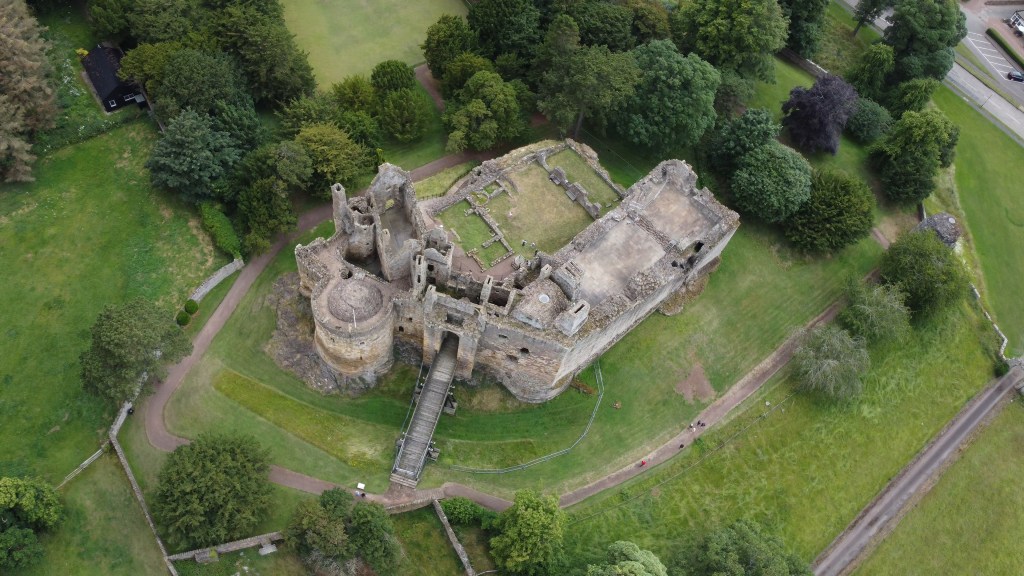
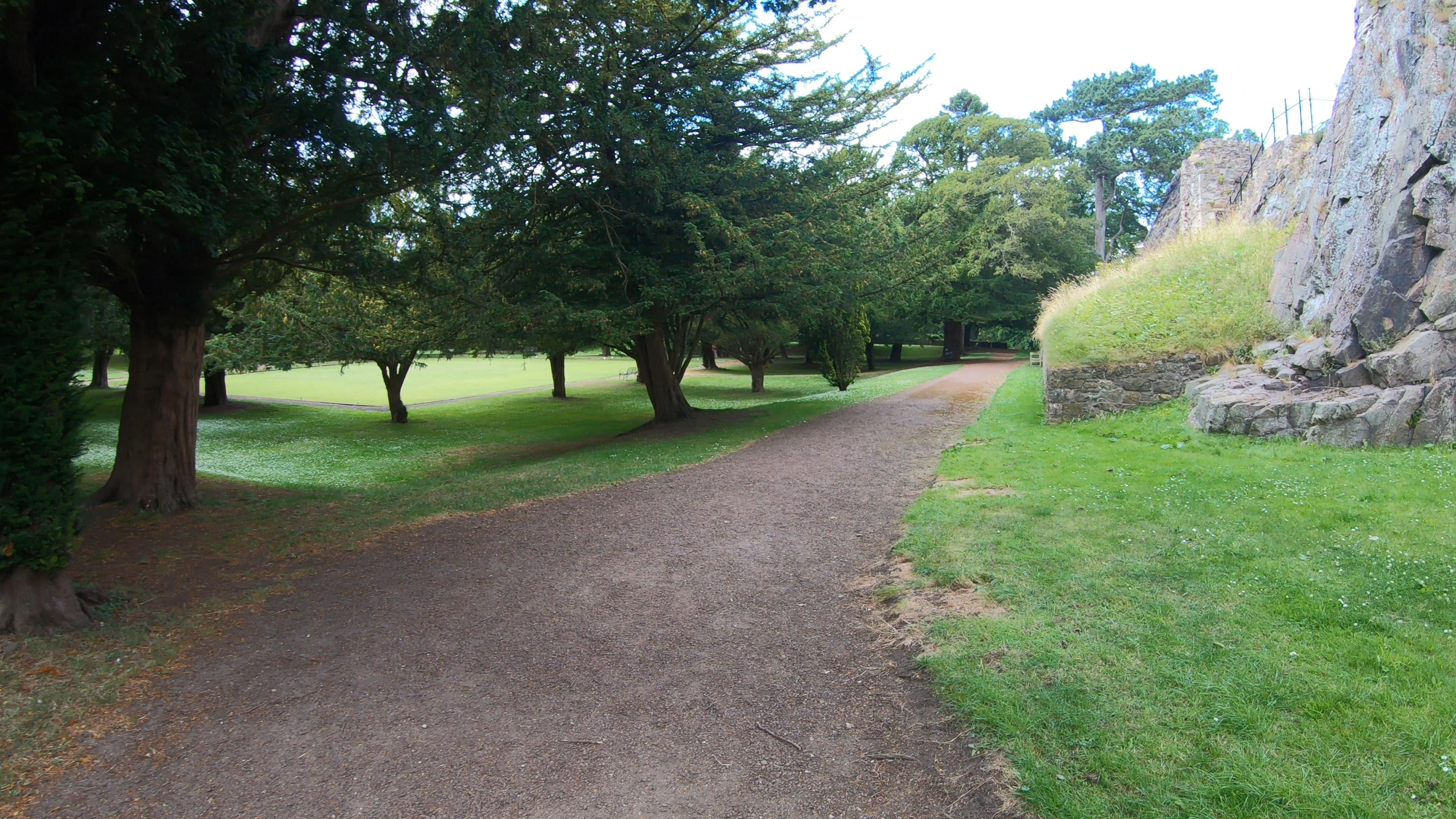
Your journey begins with a very peaceful walk through the trees of the Dirleton estate where winding paths take you through impeccably maintained flowerbeds and lawns and the castle itself is perched on top of a huge rock outcrop that must have made it an almost impenetrable fortress 800 years ago. Although much of the fortified building is in ruins it’s still an impressive place to walk around and there are enough interesting features throughout to keep you in awe with history of sieges, famous families and tales of witchcraft, so join us as we explore Dirleton Castle.
Dirleton Castle has an interesting history, with three noble families whom lived and made their marks here, The Anglo Norman De-Vaux family, the Border family of Haliburton, and the rebel Perthshire family of Ruthven. Each adapted their home in line with all the changing fashions and what we get to experience is a combination of styles from the 1200s to the 1500’s. But because of the castle’s position on an ancient invasion route, and its stormy history, it passed through the hands of many other feuding Scots families and invading English.
In ancient times the whole area was marshland and the castle’s rocky knoll itself surrounded by a deep ‘fresh water’ ditch but its worth noting that since there were at least 16 toilets that emptied into the ditch it really can’t have been too fresh, shielded by a wooden palisade which extended east to protect the castle-town village, as well as two drawbridges, one postern footbridge facing east to the village, and one larger bridge for horse, cattle and wagon access facing south. Not forgetting the castle itself which contained five round towers, three being D-shaped in plan and two Donjon type, with a further two square plan towers, all connected by a battlement wall hugging the rock knoll, giving the confused plan we see today.

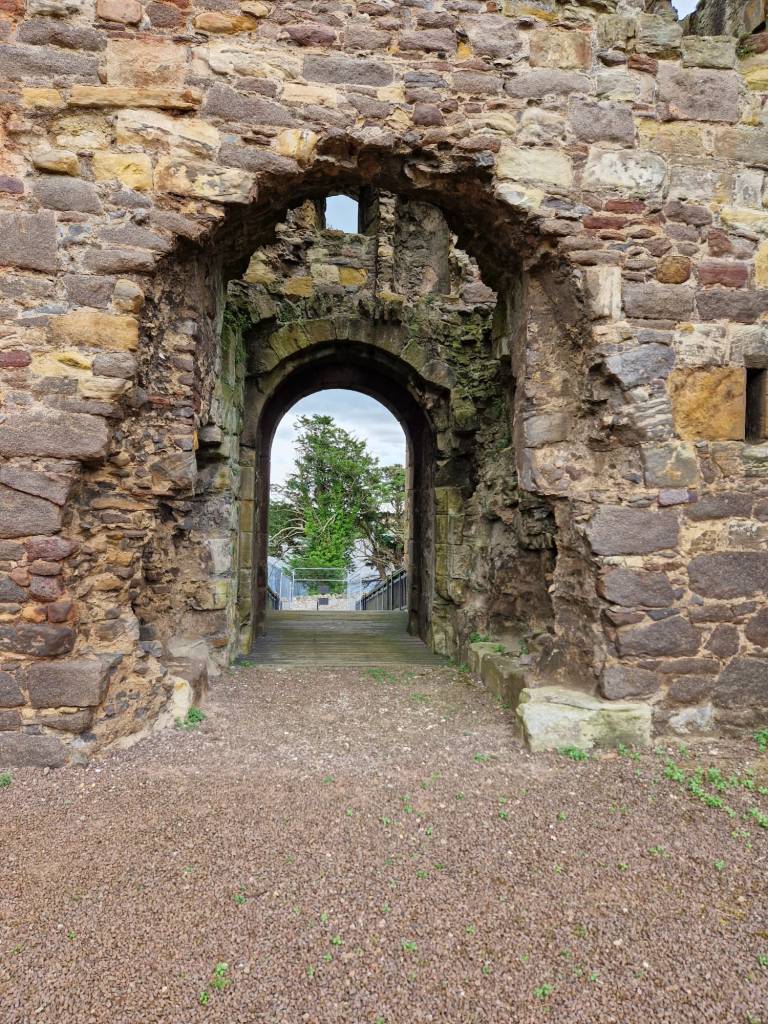
Although we don’t enter the castle through it’s original gateway to enter the castle, we can still see glimpses of the drawbridge and the gatehouse. It was built in the 1300’s and replaced an earlier entrance that was destroyed in the Wars of Independence. The gatehouse itself was a formidable structure and it really was designed not only to impress visitors but intimidate any enemies. The entrance passageway was heavily defended by a recipe of timber doors, a portcullis and iron grills, interestingly they also have a murder hole above, through with defenders could drop down heavy objects or a usual tactic of pouring hot liquids onto their attackers.
The castles origins were built as the family home of the de Vaux family in the early 1200s, and it was at this time that the imposing towers that dominate the castle entrance were constructed. Though originally from France, the de Vaux family were greatly favoured by King David I of Scotland who gave them the barony of Dirleton along with a considerable amount of land. Unfortunately for the de Vaux’s their time in power came to an abrupt end during the Wars of Scottish Independence and after Dirleton Castle surrendered to the siege engines of the English forces that the de Vaux’s were forced to give up their new home.


Like many other Scottish castles, Dirleton castle is said to owe much of its style to French rather than English influences. It is therefore little surprise that Dirleton is often linked with Coucy-le-Chateaux, north of Paris, in France. This design of a larger keep and lesser D-shaped towers set in a curtain wall can also be seen at other Scottish castles like Bothwell, Inverlochy and Kildrummy castles.
The first proper glimpse of the inside is in the heart of the courtyard, originally this would have been surrounded by a curtain wall and several towers, and from here we can see the east range built by the Haliburton’s, and then wander inside on the right to the lodgings known as the Ruthven lodgings, these were the last buildings to be constructed on the site, with the last lady in the family living in the castle till 1605. The lodgings are built from rubble with carved stone and in this block was the modern and elegant block of bedchambers added by the Ruthven family after 1515, they fashioned new features such as floors with green glazed tiles and leaded glass in the windows.

Beneath the chapel and beneath the great hall are the very impressive and enormous four storage cellars, which was the place to store all of the castles provisions, including wine, ale and fresh meat and produce. The cellars down here contained a bakehouse at one end and at a later date, a postern gate that was added dating back to the 1200’s, but this was blocked up by the Haliburton’s where they made it into a large fireplace instead, the redundant portcullis slots were reused cleverly to extract the smoke.


These cellars are so remarkable in size when you think that their use is for storage, in essence not needing this amount of excessive space as the ceilings would be too high to hang supplies from and it wouldn’t be a good idea to over stack and pile high any provisions at a great height. It’s more than likely possible that the reason why the cellars were this grand and large is purely for bragging rights of the castles owner at the time and show people how much supply and resource he would be able to keep.

I absolutely love the views of this castle, from all the ruined openings just seeing how grand this castle once was, it’s incredible to be able to walk amongst this beauty and have a true Scottish castle experience here at Dirleton.
If you liked the blog please hit that like button, watch the full video below and consider subscribing if you haven’t already.
Till Next Time!
 Pinned on Places
Leave a comment