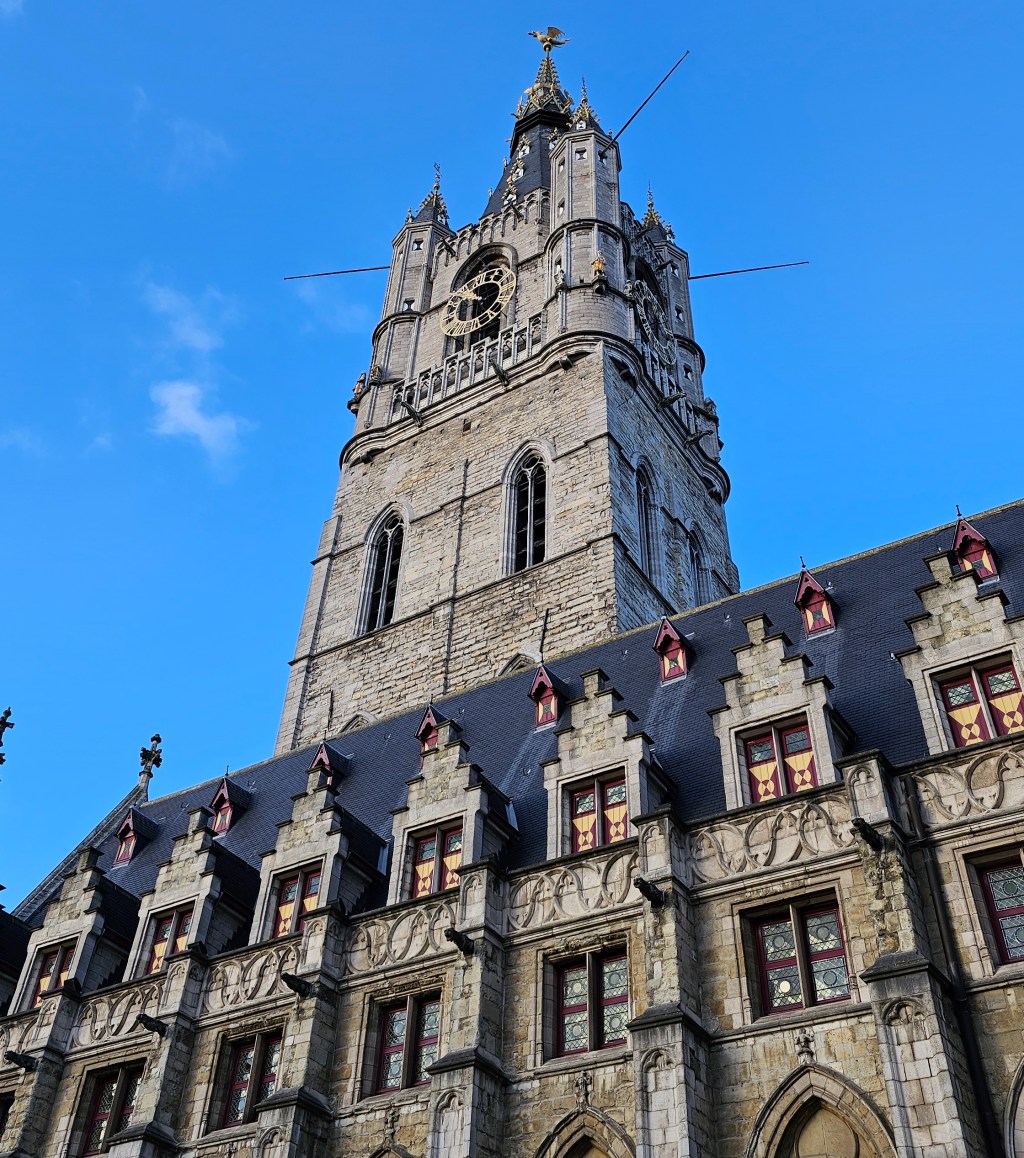
Our walk and explore in this blog post was around the belfry of Ghent, One of the city’s most famous landmarks and we’d love it if you’ll join us whilst we visit.
The visit starts in the cloth hall, this was once a marketplace for the wool and cloth trade and was built onto the Ghent belfry, construction works started in the 15th century, but it wasn’t until 1093 that the original plan for the cloth hall resurfaced and the construction executed as originally intended. But by the time construction was completed, the cloth industry was already past its prime, a lack of funds means that only 7 of the planned 11 facades surfaces were built.


The belfry of Ghent was intended as a tribute to the power struggle between the people of Ghent and the Count of Flanders since the 11th century, the belfry symbolised the political power that the trades and guilds had gained on the city’s council. It also symbolises the city’s prosperity and independence. As one of the belfries of Belgium and France, the belfry of Ghent is recognised as a UNESCO world heritage site, the 300 feet high bell tower was completed in the 14th century and it’s the middle one of the three towers of Ghent, located in between the St Nicholas Church and St Bavo’s Cathedral, later you’ll see these views from the top, which are so spectacular.
The belfry is considered the most important landmark for the city and one that has witnessed centuries of Ghent’s history as well as symbolism. The tower took over 60 years to complete due to interruptions from war, plagues, and political unrest. It initially functioned as a bell tower, storage for municipal archives, treasury, and watchtower manned by town guards.

On the first floor of here you can enjoy more about the Belfry’s history in time and of course the tale of the dragon. A dragon statue tops the Belfry of Ghent ever since 1377, but it wasn’t just the fierce ascot who watched over the city but also the guard of the city privileges which were once kept in a chest at the belfry for over a century. There’s a centuries old tradition that for very special occasions, the dragon breaths out fire. Some examples of this are the baptism of the soon to be emperor Charles V in the year of the 1500’s and the visit of William, the prince of Orange to Ghent and for 10 days back in 2018, the dragon set the sky on fire once again to celebrate the 175th edition of the wonderful Ghent Festival.
Legend has it that this gilded dragon first featured on the prow of the ship which the Norwegian king Sigrid Magnusson left with on a crusade in the 1100’s, he then offered the statue to the emperor of Constantinople for then some hundred years later, the Flemish count Baldwin IX had the showpiece transported to the Flemish region and it’s here that the Norwegian dragon ended up in the hands of the Belgium people. Over the years the dragon has been replaced with different versions, some of them are still kept inside the belfry museum and there is still a proud dragon on top of the Belfry tower.


There is a short climb to get to the level where there’s an elevator that takes you to the top, where there is the machinery for the giant bells that ring at the top of the hour. Over the centuries, the tower has been modified and expanded to accommodate more bells. Today it contains a 54-bell carillon and its historic architecture makes it a famous landmark. A Carillion is the world’s heaviest musical instrument and its here that it was installed in 1552, with eighteen bells in the belfry. The carillon now has 54 bells and weighs over 30 tons. It can be played in two different ways, the first with someone who sits behind a keyboard with sticks and pedals that are connected with the clappers and bells or there is an automatic rotating drum which makes it play. It plays music every fifteen minutes, so on your visit you’ll be sure to hear it.
Outside that room, you can walk along narrow paths on the outside of the belfry, which offer great views of Ghent in all directions and you can spot the landmarks as you wander. It truly makes the visit and the steep climb worth every bit of effort in order to experience the city from a birds eye view.


Of course if you choose not to use the lift from the first floor, you can climb 300 medieval steps that will lead you to this point. As I mentioned earlier, views like this especially on a clear day make all of the experience worth it, you can see over the city and people watch from above. With its 360 views we would imagine a trip up here during sunset would be very romantic too. The view over Ghent provides you with a snapshot of the medieval city you’ll never forget.
As we made our way back down, you’ll enter inside the exhibit room of the older bells of the belfry. Historically the bells were used to announce the time, sound warnings and announce victories. This impressive bell of the Belfry is called Roland. First it only served as an alarm bell to warn the citizens of Ghent of an approaching enemy or a battle won and It was later used to indicate each hour and therefore regulate life in the city. A collection of smaller bells followed the hourly ringing of Roland to warn the people that a new hour was almost there.

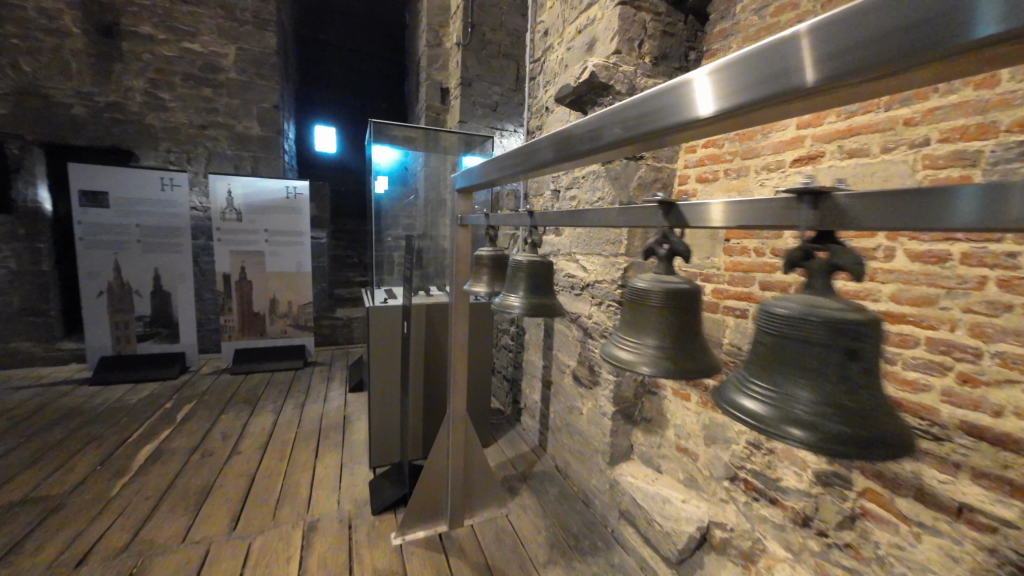
Roland’s Bell (also named “The Great Triumphant”) is named after the commander-in-chief who warned Charlemagne of danger. The bell was cast in 1314 and weighed 5,000 kg. It would be rung to warn of danger, before executions took place, and to drown out thunder. In 1659, it was melted down to cast for a new bell. The new bell was damaged in 1914 to announce the opening of the Ghent Festival so had to be replaced. Further down we get to see more medieval bells and a section of some the older bells that have been used throughout its history.
Some quick information for you if you choose to come here, The building is open every day, from 10am-6pm, tickets for an adult will set you back 11 euros, but if you have one of the handy Ghent city passes, you’ll experience here for free. It’s worth noting unfortunately however, the Belfry is not accessible to visitors with reduced mobility. If you’re looking for a gift after your visit then take a look in the shop underneath the belfry where you purchased your ticket, in there they offer some memorable gifts you can take home to remember your visit. If you’re visiting with children, VisitGent offer a children’s guide that will hopefully keep them entertained with a dragon hunt in the tower that at the end rewards them with a medal making them dragon herders for life.
So we really hope you’ve enjoyed a visit to one of Ghent’s most famous landmarks and that its given you some inspiration to visit the gorgeous belfry on your visit here. If you liked the blog please hit that like button, watch the full video below and consider subscribing if you haven’t already.
Till Next Time!
 Pinned on Places
Leave a comment