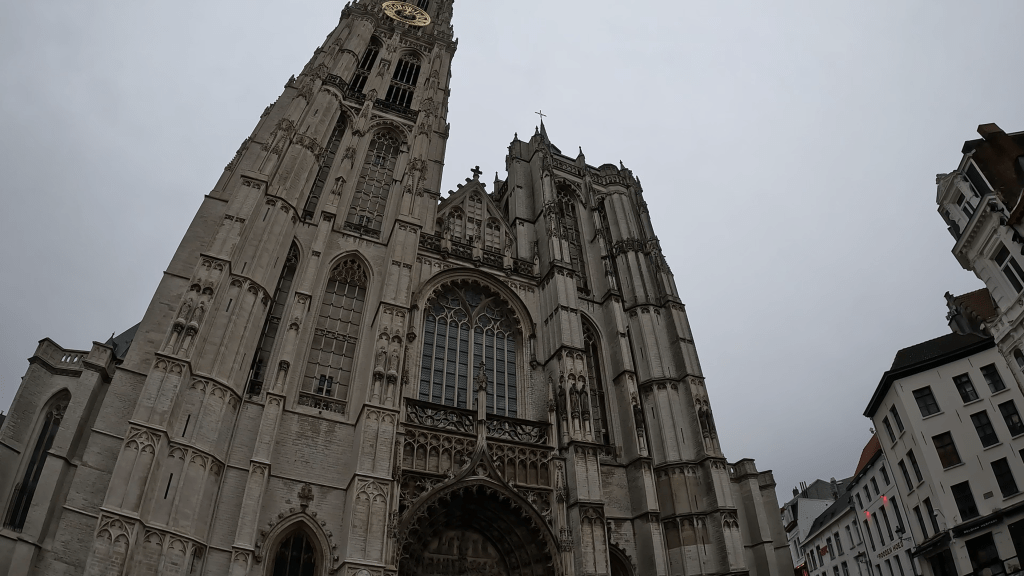
When exploring the city you can spot the imposing tower of the cathedral in the distance, it’s the highest church tower in the Belgium, rising 123 metres above the historic city centre. In the middle ages, the cathedral of Antwerp was situated inside the city centre amongst narrow and cobbled streets and gorgeous crooked houses. It was built between the 14th and 16th century, making it the largest gothic church in the low countries. The foundation of the cathedral was actually laid in the 10th century when between the 10th and 12th century a small chapel was rebuilt into a Romanesque church.


This church compromised of five aisles, to which two were added at a later date. Between the years 1350 and 1520, this church was then rebuilt into the splendid and impressive gothic building that is now known as ‘Antwerp Cathedral of our Lady’. In 1553, the church was sadly damaged largely by a roaring fire. After some extensive restoration, the church was granted the status of a cathedral in 1559. Between 1566 and 1581, the iconoclasm that coincided with the rise of protestant reformation further made damage to the church. Iconoclasm is Medieval Greek and means to break the social belief in the importance of the destruction of icons and other images or monuments, most frequently for religious or political reasons, the church was plundered several times in the years to come and its interior was destroyed. After Antwerp’s return to Catholicism, it was then restored in the baroque style and peter Paul Rubens, provided exceptional paintings to redecorate the now bare walls of the cathedral.

Two of the artworks, during Napoleonic reign, were confiscated and moved to France but were later returned to the cathedral in the 19th century. In World War 1, the Imperial German Army stole both paintings and they were then taken to the Berlin Palace, which they stayed until Armistice Day, November 11th 1918, upon being returned yet again to Antwerp.
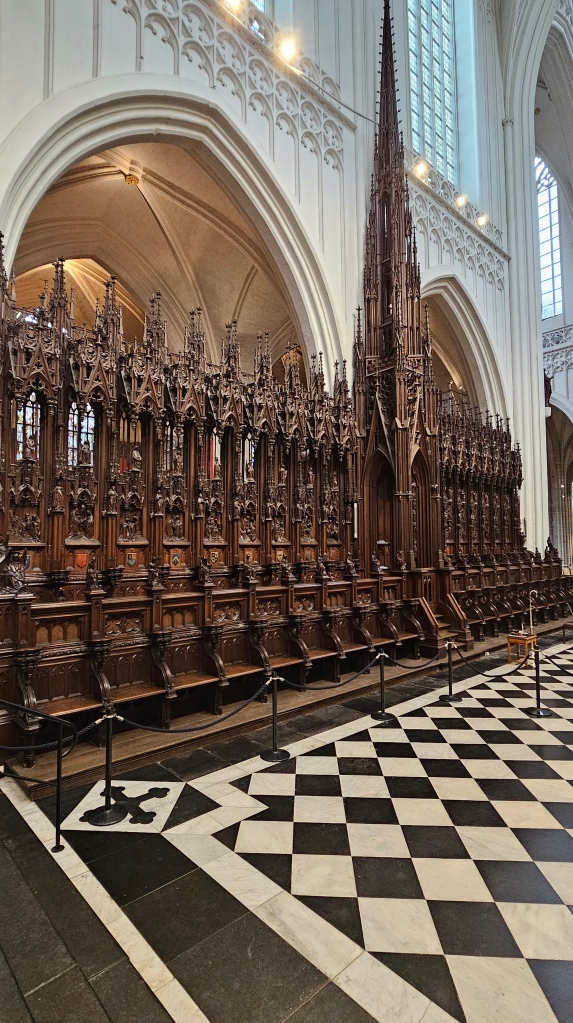
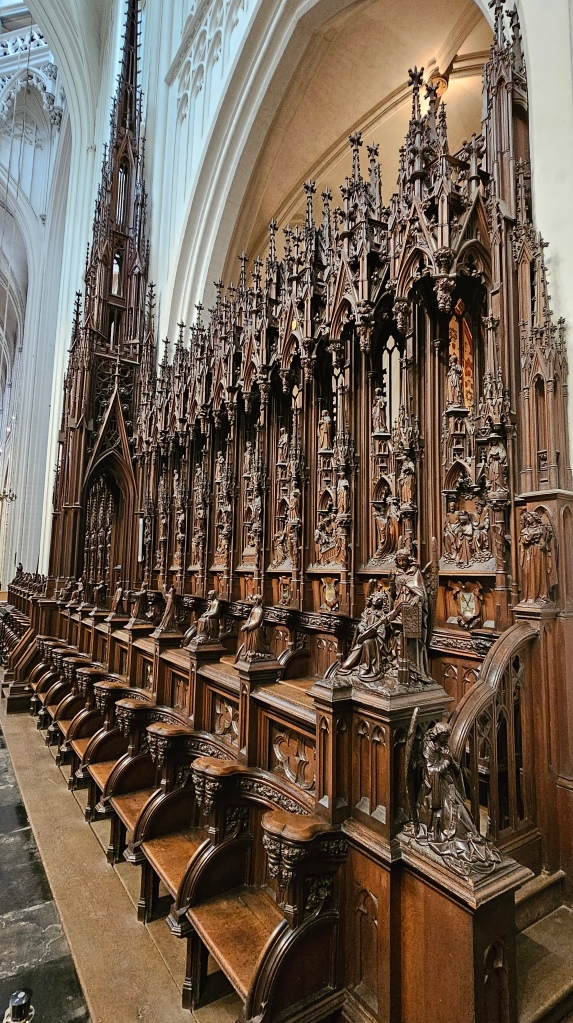
The Cathedral has an amazing set of Choir Stalls, built in the 19th Century which lines both sides of the central aisles and a pulpit, built by Michiel van der Voort, that has been in the cathedral since 1804, which was destined for St. Bernard Abbey in Hemiksem but was kept here since.

Today, as you enjoy the interior, you can see the combination of Romanesque, gothic, baroque and neo gothic styles classically portrayed. The art inside ranges from medieval wall paintings that are so impressive to baroque masterpieces by Rubens and nineteenth century paintings, although the cathedral has undergone many changes throughout it’s time when its foundations were laid in the 15th century, the medieval origins are still visible throughout.
In the middle Ages, the church interiors were once painted in bright colours. Rare examples of this can be found near the entrance to the sacristy, on the South side of the church dating back to the beginning of the 15th century. Having been hidden under layers of later wall decorations, these medieval wall paintings were revealed in the twentieth century. Some of them were remarkably only discovered twenty years ago, such as a fragment of the depiction of the Man of Sorrows.


Near the Mary chapel on the North side of the cathedral one can find a fourteenth-century statue of Mary and Jesus. This statue is attributed to the anonymous “Master of the Maasland Marble Madonna’s”, who worked in the Belgian city of Liège around 1350. Mary’s gracious attitude, the flowing folds of her gown and the serene expression on her face reflect the courtly culture of the fourteenth century.
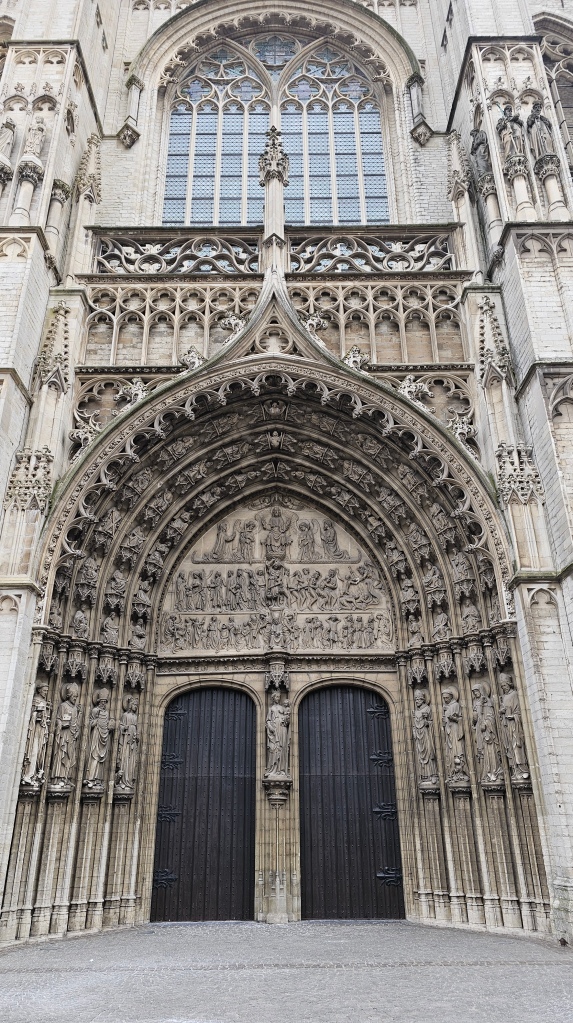
The Cathedral is one of the highlights of the Netherlandish Gothic style, with intricate stone lacework and high spires. It is worth paying special attention to the medieval ribbed vaults in the aisles. They support the high Gothic windows, and they confer grace and the sensation of immeasurable height to the church.

The four paintings by local artist Peter Paul Rubens (1577-1640) are often the main draw for visitors to Antwerp Cathedral. Some of these works include the painting above the main altar, two large triptych altars, and a smaller altar that was painted for a private tomb. Antwerp was past its economic peak by the early 17th century but it still experienced an artistic golden age at the start of the Baroque, which played a major role in the Counterreformation in the city, as it did in many parts of Europe.

Bearing history in mind, it is good to start with the youngest of Rubens painting named the Assumption of the Virgin hanging in the choir above the main altar. The Protestants and Dutch Protestants in particular, were against church art to start off with but a theme such as the assumption of the Virgin – a story not in the Christian Bible but popular with Roman Catholics – is enough to get any protestant’s back up.
Next is the The Raising of the Cross but also known as The Elevation of the Cross which is the oldest and biggest painting by Rubens currently inside Antwerp Cathedral. This was originally painted for the main altar of the St Walburgis Church in Antwerp but this church has since been destroyed with the Ruben altar inside the cathedral since 1816. It is currently now in the north transept.
The Descent from the Cross painted by Rubens in 1611-14 is usually considered artistically the most accomplished work by him in the Cathedral. It is more classical than The Elevation of the Cross and considered a paragon of the Baroque genre. The harquebusiers had St Christopher as patron saint. As he famously carried Christ – as painted on the rear of the altar – the front three pictures also involve Christ being carried. The central panel has Christ being taken from the Cross by eight figures. On the left side panel, an expecting Mary visits her cousin Elizabeth, who is expecting the later John the Baptist. On the right panel, Mary hands the infant Jesus over to the high priest Simeon.
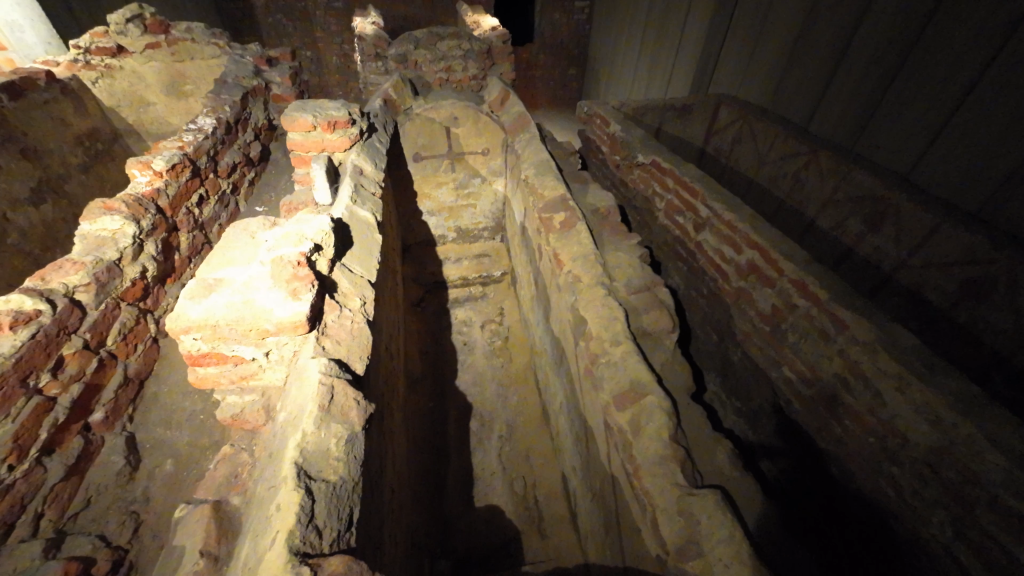
What we didn’t realise is there is a small crypt underground, accessed by a small spiral staircase, which houses 4-5 tombs, all empty, but an interesting find that we stumbled across. These were laid out more like an archaeological dig, with barely enough room for movement, and all exhumed, but an interesting stop on your visit to imagine how many other burial tombs are below the cathedral itself.
These altars by Peter Paul Rubens largely account for the large number of Japanese visitors to Antwerp Cathedral. These Rubens altars play an important role in A Dog of Flanders – a 19th-century book by English author Marie Louise. The story became hugely popular in Japan through manga, television and films but in the novel – it centres around the lives of young orphan boy named Nello who was an aspiring painter and joined at the hip by his dog Patrasche.
The scene of a dog in Flanders follows a desperate Nello, who after being wrongly accused of causing a fire in his village, heads to the cathedral in Antwerp to see and experience his idol Ruben and his paintings of the elevation of the cross, however he was out of money and unable to see the artwork. On Christmas eve Nello and his dog stayed at the cathedral when they found the doors left wide open, the next morning, the boy and his dog are discovered frozen to death underneath his favourite artists paintings. The tragic ending inspired more than a few fans over to Antwerp, but there was nothing dedicated to the story in the country as most were even unaware of its international popularity. Most recordings of the story, especially in the USA, use a happier ending but in Japan, the original resonates well.

During the 1980s, Antwerp finally introduced a small statue of a boy and his dog to a suburb of Antwerp where the novel is believed to have been set and now we can see and experience the marble statue outside of the cathedral itself depicting Nello’s last moments with his loyal best friend Patrasche, covered up by a cobblestone blanket, forever together.
The fourth Rubens work in Antwerp Cathedral is much smaller but biblically speaking of a much more important event – The Resurrection of Christ. This painting was made for for the married couple Jan Moretus and Martina Plantin, from the family of printing fame at nearby Museum Plantin-Moretus, the central panel shows Christ emerging alive from his tomb to the shock of the roman soldiers, then the side panels feature John the Baptist and St Martina, who were the patron saints of the Plantin-Moretus couple.
These masterpieces truly are special and worth your time to experience and depict yourself. We also went to the Printing Press of Moretus, so stay tuned for that soon upcoming in a video.
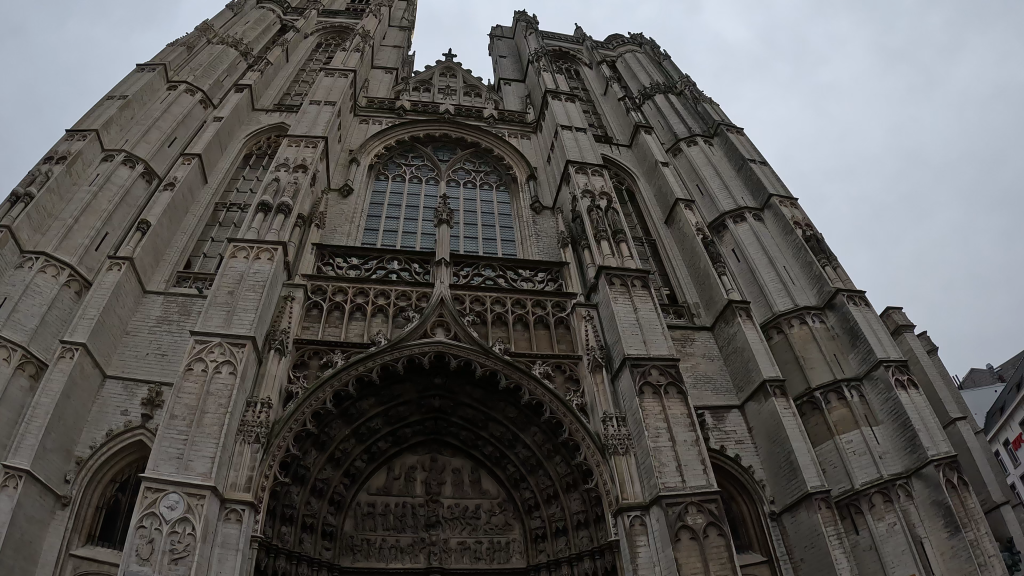
The interior of the Cathedral of our Lady is open 10am to 5pm on Weekdays, 10am to 3pm on Saturdays and 1pm to 4pm on Sundays and Public Holidays. Be sure to check the website for these hours as they may vary if any services and/or events are happening. The price of €6 Euro for adults and children under 12 free, is definitely worth it for the amount of culture, religion, art and inner peace you will soak up during your visit. Be sure to take a leaflet when you enter to gain more understanding of the various places to visit within the cathedral.
If you liked the blog please hit that like button, watch the full video below and consider subscribing if you haven’t already.
Till Next Time!

 Pinned on Places
Leave a comment