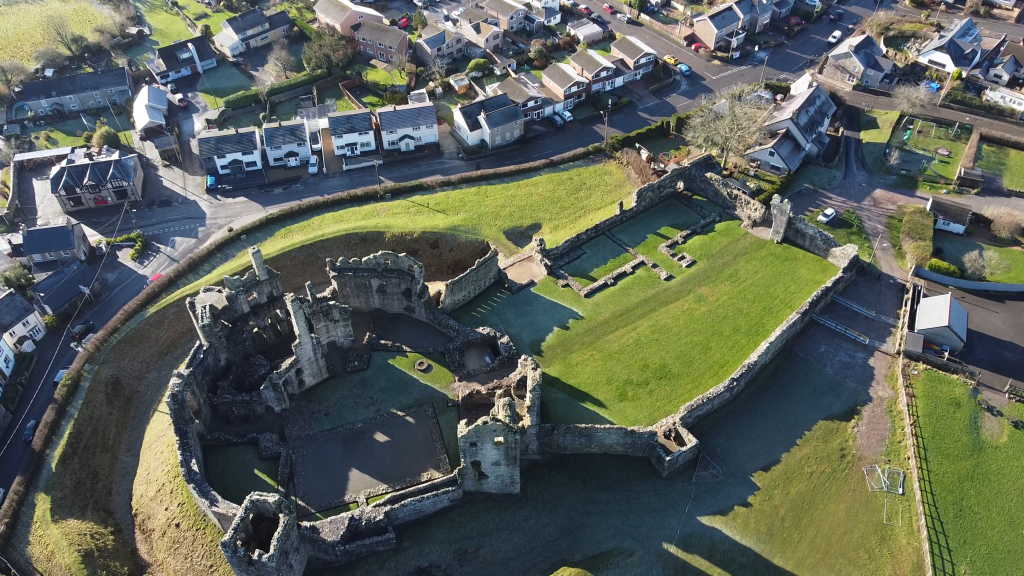
In the south of Wales near Bridgend were able to visit the beautiful and epic, Coity castle. We take a stroll around a Norman castle built by one of the legendary twelve knights of Glamorgan, and explore just what a 12th century rebuilt stronghold looks like after sieges in the uprising and at a time when the lords rose to control their portion of the kingdom.
The castle was established by the knight Sir Payn de Turberville at the end of the 11th and the beginning of the 12th century during the attack of south eastern Wales by the Norman conquerors. Turberville was one of the twelve knights who accompanied the earl of Gloucester, Robert Fitzhamon on his conquest of Welsh Glamorgan. It was throughout Wales that several marcher lordships were quickly established in the decades straight after the Norman conquest of 1066, they were rewarded by William the 1st for loyal service and the marcher lords in turn became very powerful and rich men, who created stone fortifications to control their position of the kingdom.

Robert Fitzhamon had Williams blessing to distribute the lands of Glamorgan among his own dozen of men, he handed his best lands to his favourites and forced Sir Payn to acquire land on his own. So Turberville set off to discuss the matters of Coity Castle with a Welsh leader named Morgan ap Meurig, Morgan had agreed to turn over his castle to Payn, but on one condition, either he had to fight Morgan for the lordship or he had to marry Morgans daughter. Amazingly Payn took the sword in his left hand and held his lady with his right, they then happily married and Sir Payn became the lord of Coity.
The first castle here was a typical Norman stronghold normally referred to as a ringwork. The ringwork included a circular embankment which was surrounded by a deep ditch and topped with timber palisades; a simple timber gatehouse would have controlled access into the castle.

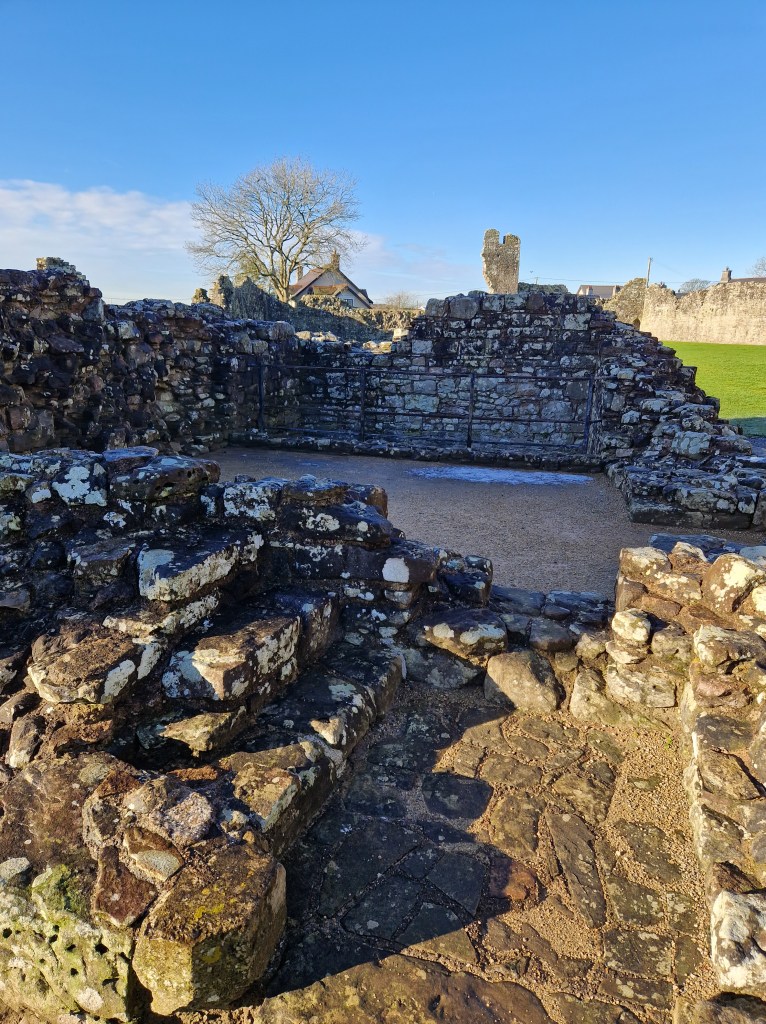
Today, the shape of the later stone built castle still reflects the original design of the ring work and by the start of the 12th century, the Norman had been able to extended the Welsh marches as far west into Wales as the lordship of Coity, two other castles joined Coity to be able to defend the lordship of Glamorgan along the western border of the marches, the first was Newcastle – built by Robert Fizhamon and Ogmore Castle which was built by William de Londres which we managed to visit his beautiful castle last year.
The three castles combined were a formidable force and each were represented by a particular lord but also belonged to Glamorgan.
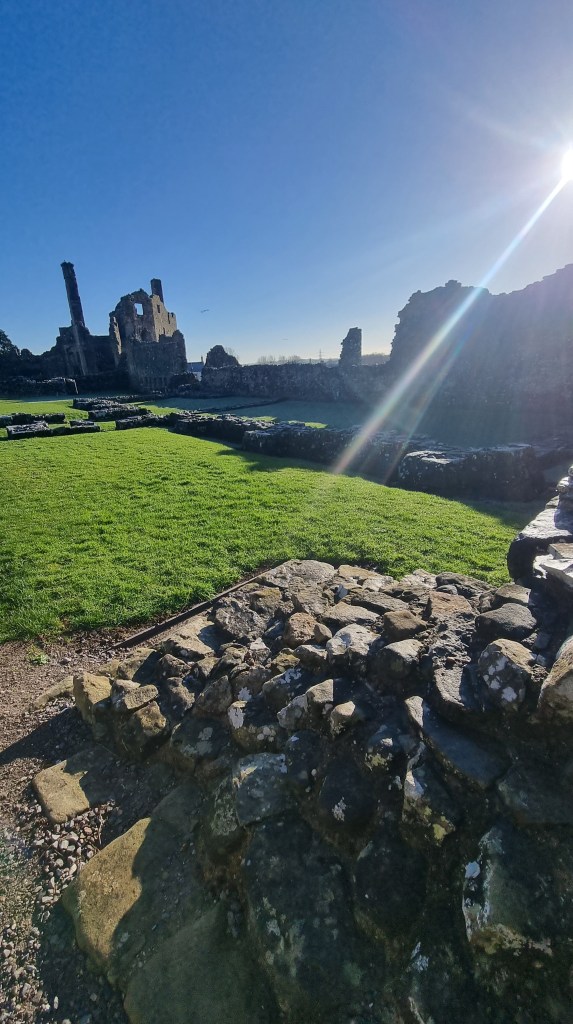

The castle was now in control by Gilbert de Turberville and during his ownership the simple castle structure was refortified with stone and Gilberts claim to fames were the keep, the curtain wall which now encloses the inner bailey and the northeast tower. Now greatly ruined, but still amazing to see the castle still retains several of its distinctive Norman features. The most well preserved parts of the castle are the battlements, the wall walk which connected the three storied keep and the eastern face. Later during the 14th century extensive upgrades were made to the castle and a fine middle gate was added, to offer access to the rather elaborate residence which sat inside the inner bailey. More Major rebuilding took place again in the 15th, after Owain Glyndŵr laid siege to the castle during his uprising against English rule.

On our way inside we explore the castles Keep which was added in the 12th century, it’s fascinating how much still remains today, what’s most noticeable is the the sheer height of the castle keep itself, it stood at three storeys high. What’s incredible about the construction here is the size and thickness of the stone holding up still to this day. The stone would have been part of extensive reworking that took place later in the 14th century when a domestic range was attached to the keep by the middle gatehouse, the very large central pier stone vault that we are able to see replaced the earlier timber floors, it’s very impressive how massive these stone vaults are and I think it’s really cool how they’ve crumbled away, but just enough so that we still have an idea how the vaulted ceilings would have held up.
From the inner ward we move around into the east gatehouse where you will notice how intact this one of three gatehouses still is today surviving. I love the entrance here with its drawbridge over the ever so important moat surrounding the castle. There is something very special about this gatehouse though, this particular one was rarely used for battle or protection hence the other two gatehouses that were more fortified, but you can tell this by the way it’s been furnished with it’s many windows and doors climbing all the way up, it was later converted into luxury apartments and now mainly used as a spot for the birds to nest but it’s really quite atmospheric inside with nature slowly taking its tole.
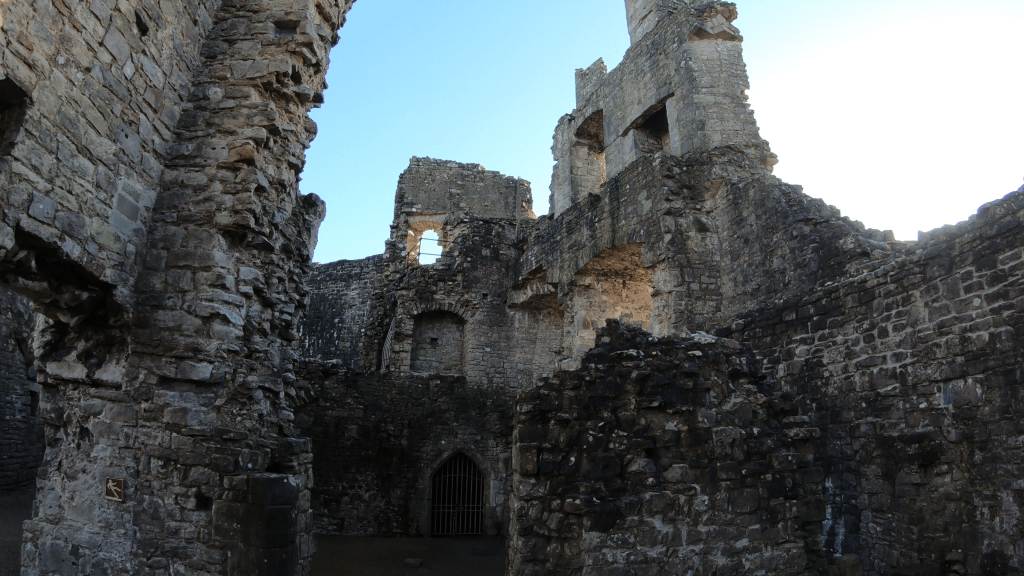
The chapel building had two floors with an entrance to the ground floor directly from the courtyard, from that point you would have been able to use the corner staircase, that’s now locked up to the first floor of the chapel. After finishing the ground floor, the chapel was then divided into three rooms by inserting partition walls, more than likely these rooms served as additional storage rooms or pantries. The upper chapel was placed onto a wooden ceiling and illuminated once by a large pointed arch window, I can imagine this room when the window would have been filled with stained glass, perhaps had the tapestries and religious beliefs hanging on the walls and the ceremonies that this place would have been very calming to visit.
Something that we noticed whilst walking around was the different additions to the centuries that past and the styles of architecture that changed, you will notice some of the stone arches that are missing the other parts and they have built a wall in its place rather than rebuilding the stone arch and building from there, it’s quite interesting to see.
Then we make our way on to into the castles great hall, this was the main area for activity especially in the 14th century when most of the living and main utilities were located here. Many feasts and important ceremonies were organized here and all the guests greeted, it was lit by the outside with three large windows and once covered with massive beams of a wooden ceiling and decorated beautifully. Being the most important room of the castle, it was accessible by the narrow living rooms on the two upper floors both that would have been heated throughout with large fireplaces and another private living room would have been just above the hall.

Inside the range, there was the local kitchen, massive fireplaces and a malting kiln, pantry, buttery, complete with stone oven. Just everything you would need to feed a household and it’s many revolving guests.
At the entrance to the site, where you’re able to park your cars for entry inside, we originally entered through the west gatehouse into the outer ward of the castle. The enclosure within is approximately rectangular in shape, 100 feet wide and 170 feet long, protected by curtain walls which are highest along the north edge, it was a section that includes a square based tower. The southern walls contain another gatehouse, mostly just foundations, south of which is a short bridge over the end of the grassy moat. The wall segment linking this to the inner bailey includes a neat row of gun loops. The only other structure within the outer ward was a two room barn with porch, its footprint clearly evident from the low wall remnants.

Our time here has been so interesting to visit, Coity really reminds me of the other incredible Welsh strongholds in the south of Wales, mainly Llawhaden Castle and Grosmont Castle. But I may say this alot in our visits, but Coity really is a stand out and one not to be missed off the list.
If you liked the blog please hit that like button, watch the full video below and consider subscribing if you haven’t already.
Till Next Time!
 Pinned on Places
Leave a comment