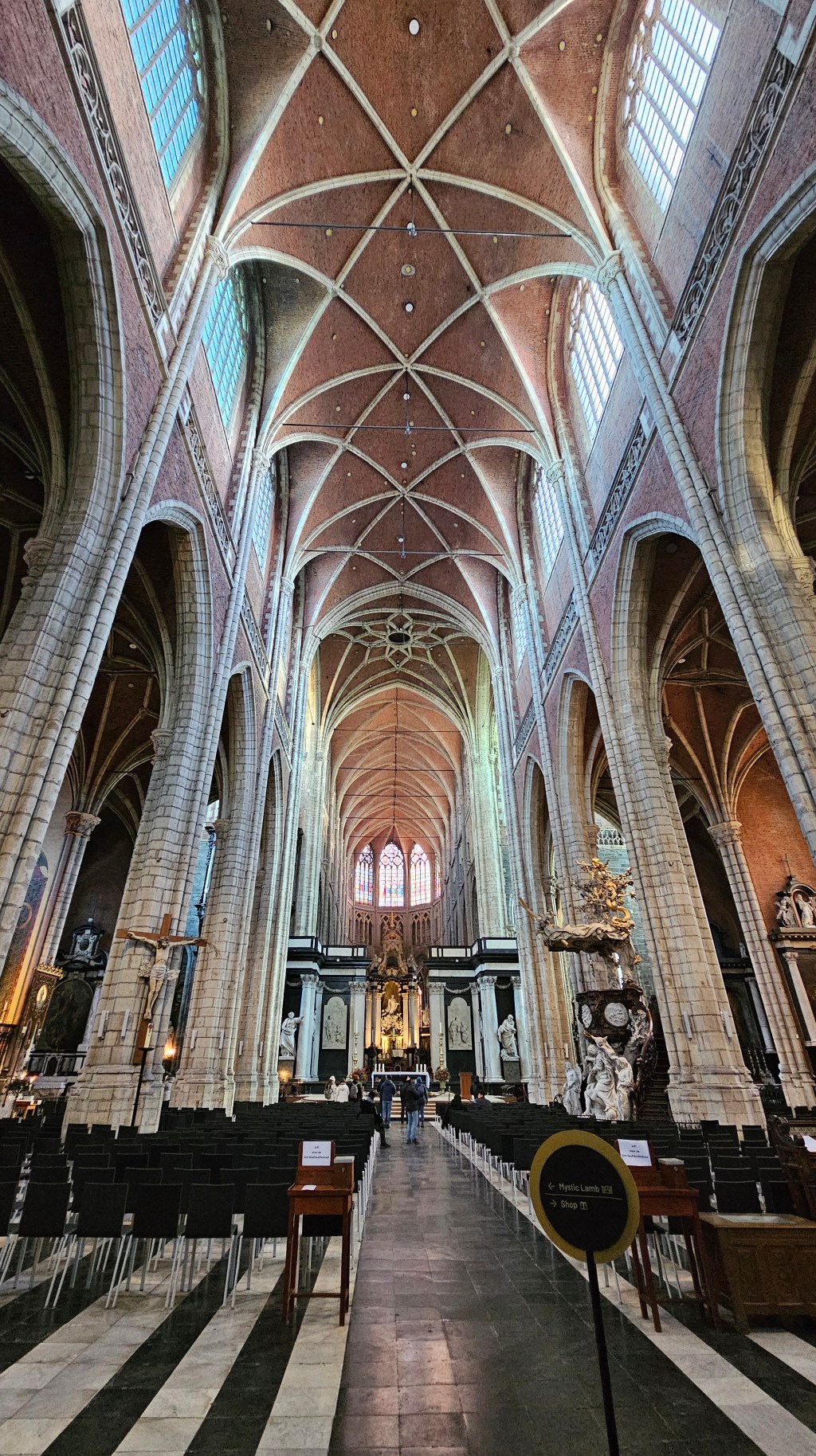
The origins and consecration of the church on this site was in AD 942 to saint john the Baptist and interestingly you can still find some traces of the following Romanesque church which dates to around the mid 12th century, in the crypt that is wonderfully decorated with murals. Whilst we wander the beautiful cathedral I’m going to try and tell you some of the history that makes this place wonderful in it’s own right.

The city of Ghent was one of the most powerful and wealthy cities in western Europe, during the middle ages and they would always be able to afford to build bigger and grander churches, an example of this is St Johns church that was converted in the gothic style in the 15th and 16th centuries. In the middle of the 16th century, this building still had the appearance that it has today, but other changes were soon to follow.
Around 1536 the age old saint Bavo’s abbey was dissolved on the orders of Emperor Charles V, the majority of the abbey was demolished after the Ghent uprising in 1540 and was then converted into barracks, both the abbot and monks of this abbey were now in power and given the title of canon, their chapter passed to the saint johns church, which was then called Saint Bavo’s church. The church of Saint Bavo was also the site of the baptism of Charles V.
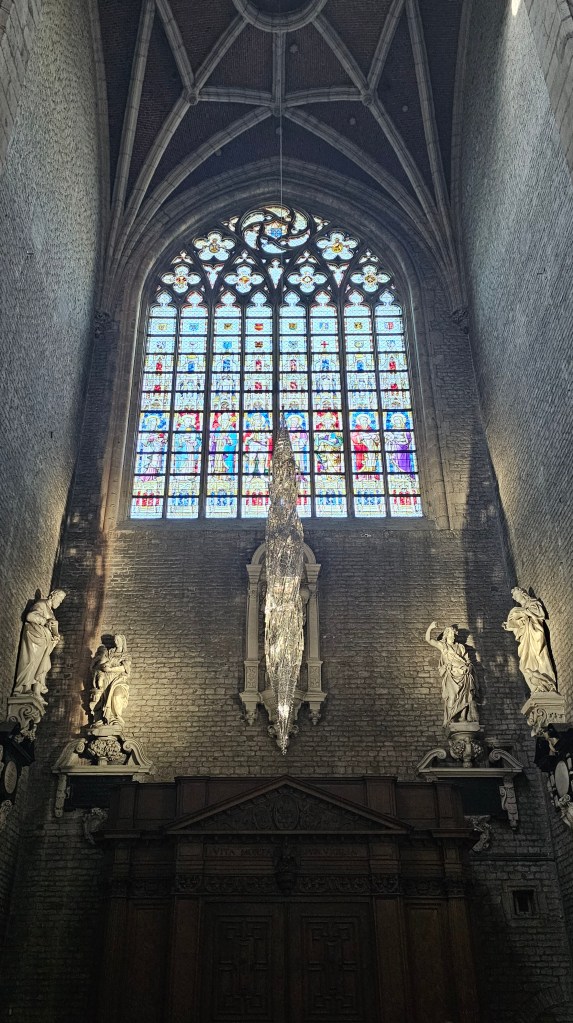

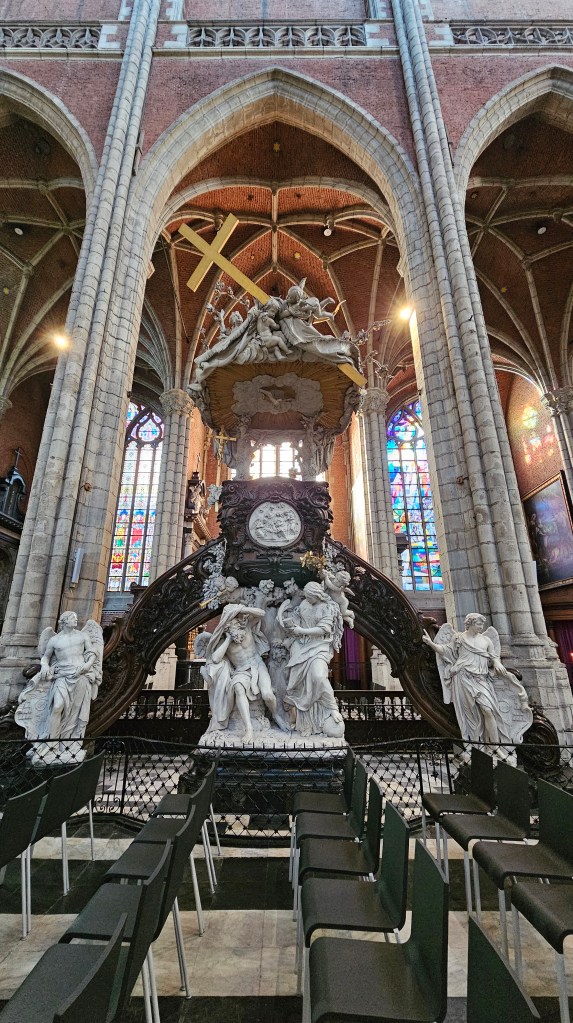
The area that was controlled by the bishop of Ghent was founded in 1559 and the church became St Bavo’s cathedral, amongst the long line of shepherds, one of those was the seventh bishop, named Antonius Triest, that should be mentioned for his stamp and personality on the cathedrals very rich baroque interior that we can enjoy today. The transformation took quite some doing, becoming especially tricky when the decision was made to ditch the cathedral’s original Roman look and to completely reinvent it, in it’s now, Gothic-style.
St. Bavo’s showpiece is the 24-panel altarpiece The Ghent altarpiece, It is formally known as The Adoration of the Mystic Lamb by Jan and Hubert van Eyck. This work is now considered Van Eyck’s masterpiece and one of the most important works of the early Northern Renaissance, as well as one of the greatest artistic masterpieces of Belgium. Several of the painting’s wings were bought in 1816 by the English collector in Berlin, named Edward Solly.
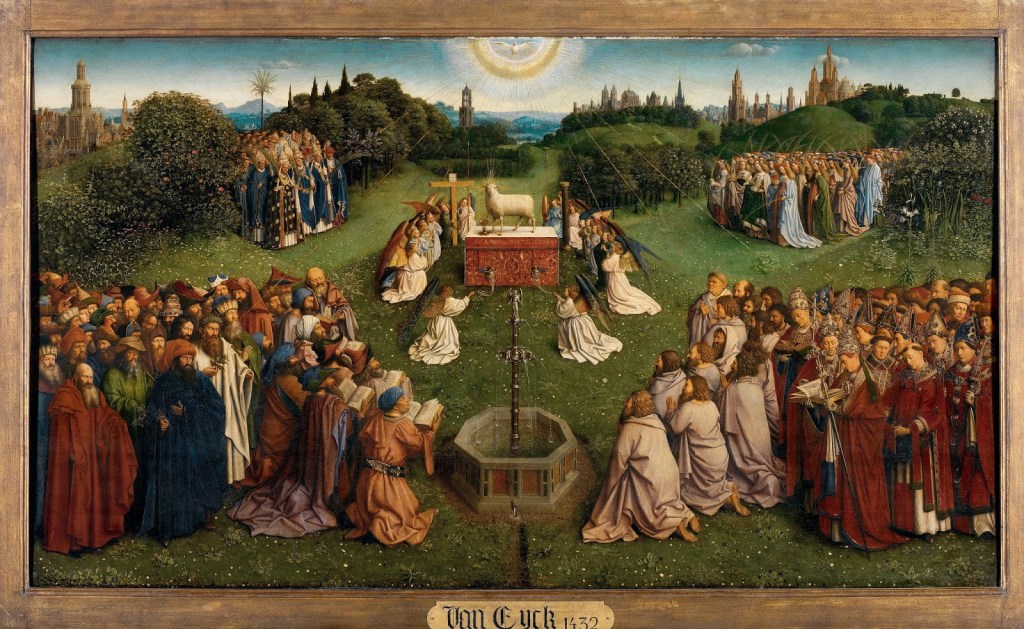
Later, in 1821, these were bought by the King of Prussia, Frederick William III, and continued to be kept in Germany. During World War I, other panels were taken from the cathedral by German occupation and as part of assigned compensation in the Versailles Treaty, Germany returned the poached panels along with the original panels that had been legitimately bought by Solly, to help compensate for other German ‘acts of destruction’ during the war.
The Germans ‘bitterly resented the loss of the panels’, and at the start of World War II with Germany in 1940, a decision was made in Belgium to send the painting to the Vatican to keep it safe. The painting was enroute to the Vatican, in France, when Italy declared war as an Axis ally alongside Germany.
The painting was stored in a museum in Pau, France, for the duration of the war. Later, In 1942, Adolf Hitler ordered the painting to be seized and brought to Germany to be stored in a Bavarian castle. After Allied air raids made the castle too dangerous for the painting, it was stored in a salt mine. Belgian and French authorities protested the seizing of the painting, and the head of the German army’s Art Protection Unit was dismissed after he disagreed with the seizure.

The altarpiece was one of the countless cultural works stolen by Hitler’s armies during World War II. All twelve panels and seventeen feet of it were taken from the Cathedral of St. Bavo and, dismantled, it was hidden away in the salt mine in Austria. Hitler intended to make a Führermuseum where he’d display all the greatest works of art he could get his hands on and The Altarpiece was subsequently found by the Monuments Men and ultimately returned to Belgium and its rightful place in the Cathedral.
Interestingly, Not all panels made it out of the war. After its trip to the Austrian salt mine and dramatic rescue, it was discovered that one of the lower left inside panels was missing. The panel featuring the ‘Just Judges’ worshipping the Lamb was gone. So a replacement had to be commissioned and to this day that replacement panel is the one you will see if you visit the Altarpiece.
It begs the question, just where is the missing panel? I’m not able to answer that, it could very much Still in the depths of Austria, Decaying on a forgotten roadside somewhere? Or hidden away in a private chalet? The imagination runs wild, but this story and crazy journey for the painting itself is so interesting.

When visiting the cathedral, it’s worth noting that importantly, the back half of the main nave as well as the crypt is now reserved for those with ticketed entrance for the Ghent Altarpiece and Augmented Reality (AR) tour experience. Tickets can be purchased through the church website or at the ticketing booth while opening hours are 10am to 5.30pm (Mon to Sat) and 10am to 1.30pm (Sun). We sadly didn’t have the time to visit and do the tour as we were too late to go see it on the Sunday. But we plan on revisiting and definitely experiencing the works of art.
While most of the visitors come for the Mystic Lamb, the cathedral is itself an impressive building that deserves more attention. It is an encompassing structure in down-town Ghent with a spacious and solemn interior. There are other outstanding works of art including one of the oldest preserved books in Belgium, called the Livinus manuscript that contains four gospels and it dates back to the 8th century. Not only that but works of art by the famous Flemish artist, Paul Reubens, which you need to experience and look for.
If you have purchased and are using the Ghent City-Card, bought from the Ghent Tourist Office outside of Castle Gravensteen, De Lijn public transport shops, hotels and participating museums, then you are able to get a large discount for the AR Experience, otherwise an adult ticket will set you back €16 Euros.
If you want to just experience the cathedral, this is Free. St. Bavo’s cathedral is fully accessible including the crypt and altarpiece experiences, but please ask the reception team at the entrance of the cathedral for any assistance!
If you liked the blog please hit that like button, watch the full video below on our Tour of Ghent and consider subscribing if you haven’t already.
Till Next Time!

 Pinned on Places
Leave a comment